
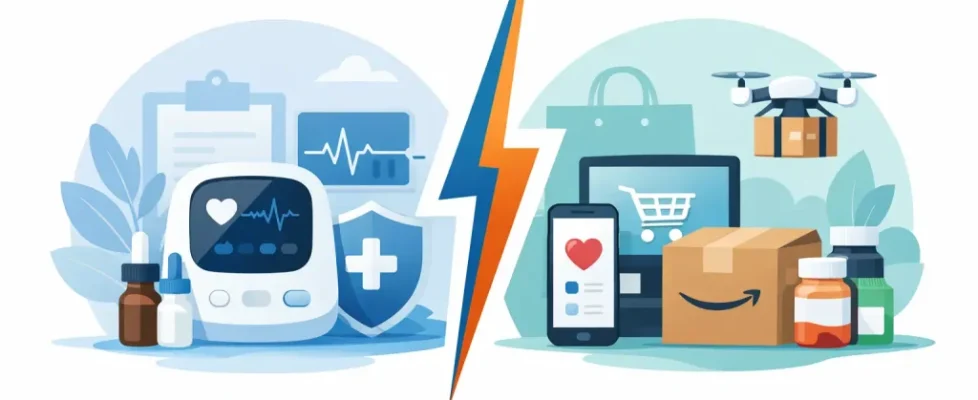
dr. miltie n9+ vs. amazon health
If your organization is comparing dr. miltie n9+ vs. amazon health, the real question is not which brand is bigger. It is which model of virtual care actually supports clinical work beyond a video visit. For provider groups, rural facilities, community health centers, pediatric programs, and home-based care teams, that difference matters because virtual care fails fast when it cannot capture meaningful patient data, support remote exams, or fit reimbursement-aware workflows.
Amazon Health enters the conversation with consumer recognition, broad reach, and a familiar digital experience. That visibility can be attractive for organizations that want easy access points and a recognizable front door for basic virtual encounters. But healthcare operators do not buy telehealth based on name recognition alone. They buy for care model fit, documentation quality, scalability across patient populations, and whether the technology can help clinicians assess, monitor, and follow patients with confidence.
dr. miltie n9+ vs. amazon health: What are you actually comparing?
This comparison only makes sense if the categories are clear. Amazon Health is often understood as a consumer-oriented healthcare access platform focused on convenient entry into care, including virtual visits and related services. Dr. Miltie N9+, by contrast, is positioned more as a connected-care and remote examination platform built for healthcare delivery organizations that need clinically relevant interaction, data capture, and operational utility.
That distinction is not just marketing language. A convenience-first platform is designed to reduce friction for scheduling and basic consultations. A connected-care platform is designed to extend the clinical environment beyond the four walls of a clinic, hospital, school, or community site. If your use case is limited to low-acuity virtual consults, both may appear to solve the same problem. Once you move into chronic care management, pediatric assessment support, follow-up monitoring, rural access, or distributed care teams, the gap becomes more visible.
Where Amazon Health may fit best
Amazon Health can make sense when the primary goal is straightforward access. Organizations looking at basic on-demand virtual care, consumer familiarity, and relatively simple digital touchpoints may see value in that model. For low-complexity use cases, convenience has real operational benefit. Patients may be more likely to engage when the path to care feels familiar and simple.
That said, convenience is not the same as clinical completeness. If a provider needs more than conversation-based telehealth, limitations can emerge quickly. A standard virtual interaction may help with triage, medication questions, or minor episodic concerns, but it may not support the level of remote examination or structured patient data collection needed for more complex cases.
This is especially relevant for pediatric populations, patients with special healthcare needs, and individuals receiving care in the home or in geographically dispersed settings. In these environments, a video-first model can fall short when providers need to assess more than what can be seen on a screen.
Where Dr. Miltie N9+ changes the evaluation
Dr. Miltie N9+ is more compelling when the organization is not simply digitizing appointments but expanding clinical reach. That means enabling remote exams, supporting connected peripherals or device-based assessment workflows, and generating data that is clinically useful rather than merely conversational.
For healthcare leaders, this matters because telehealth adoption often stalls at the exact point where clinicians ask a reasonable question: can I make a better clinical decision with this platform, or am I just recreating a thinner version of an office visit? Platforms that support remote assessment and monitoring answer that question more effectively.
In practical terms, Dr. Miltie N9+ aligns better with organizations managing chronic disease follow-up, post-acute monitoring, school-based care, rural outreach, and specialty access extension. It also aligns with teams that need better continuity between patient contact, data review, care management, and documentation. Those are not fringe use cases. They are core operational demands across community-based and distributed care models.
Clinical capability is the dividing line
The central issue in dr. miltie n9+ vs. amazon health is clinical capability. Not every organization needs remote exam depth, but those that do cannot treat it as a nice-to-have. When clinicians need to evaluate symptoms, track status changes, support chronic care management, or monitor patients between visits, the platform has to do more than host a call.
A platform built around connected care can help collect clinically relevant data from the patient environment. That can improve follow-up quality, reduce unnecessary travel, and support care in familiar settings, which is particularly useful for children, older adults, and patients who experience high stress in traditional medical environments. For pediatric and neurodiverse populations, familiar settings can improve cooperation and make assessments more representative of baseline behavior.
Amazon Health may still be useful as an access layer, but if the clinical objective depends on remote examination support or longitudinal monitoring, the provider organization may need more than a consumer-facing health service model can consistently deliver.
Workflow, reimbursement, and operational reality
Healthcare organizations do not implement telehealth in a vacuum. They implement it inside staffing limits, documentation requirements, compliance expectations, and reimbursement constraints. This is where many comparisons become more serious.
A consumer-friendly experience can help with adoption, but provider organizations also need workflows that support care coordination, documentation quality, chronic care programs, and scalable follow-up. If the platform creates extra manual work for clinicians or care managers, its initial appeal fades quickly. Operations leaders will also look for alignment with HIPAA compliance, patient communication pathways, and the ability to support reimbursable virtual services where applicable.
Dr. Miltie N9+ is better understood through that operational lens. Its value is not only that it supports virtual interaction, but that it is oriented toward care delivery programs that need measurable utility. In settings such as federally qualified health centers, long-term care, home health, and rural outreach, technology earns its place when it supports actual workflows and extends scarce clinical resources.
Amazon Health may serve organizations that prioritize patient acquisition or front-end convenience. But if your team is responsible for remote patient monitoring strategy, chronic care management performance, or distributed specialty access, convenience alone will not close the gap.
dr. miltie n9+ vs. amazon health for pediatric and rural care
This is where the comparison becomes less abstract. In pediatric care, especially for children with special healthcare needs, virtual care has to reduce burden without reducing clinical confidence. Families often need care options that limit travel, minimize waiting room stress, and make it easier for caregivers to participate. A platform that supports richer remote assessment is better positioned for those realities than one centered mainly on standard virtual visits.
In rural settings, the stakes are similarly high. Rural clinics and critical access facilities are not just looking for a digital front door. They need tools that help extend specialists, support local teams, and reduce the need for avoidable transfers or long-distance follow-up. A connected-care model can be more useful because it strengthens clinical decision-making at the point of care, even when the specialist is remote.
That does not mean every rural or pediatric program needs the same platform depth. A school-based nurse consult program may have different needs than a cardiometabolic monitoring initiative or a home-based pediatric follow-up service. But in both cases, the more the care model depends on examination quality and patient data outside the clinic, the more Dr. Miltie N9+ stands apart.
Which option is better for providers?
The answer depends on what kind of telehealth problem you are trying to solve. If you need accessible, relatively simple virtual care with strong consumer familiarity, Amazon Health may check the box. If you need a platform that helps clinicians do more remotely, not just talk remotely, Dr. Miltie N9+ is the stronger strategic fit.
That difference matters most for organizations building long-term virtual care capability rather than short-term access points. Health systems, physician groups, home-based care providers, and safety-net organizations increasingly need telehealth tools that support remote examination, monitoring, continuity, and reimbursement-aware care models. In that environment, broad consumer recognition is less decisive than clinical usefulness.
Telehealth.Today often covers this exact shift in market expectations: virtual care is moving from convenience service to care delivery infrastructure. Buyers who understand that shift tend to ask harder questions about data quality, assessment capability, workflow integration, and scale. Those questions favor platforms designed for connected care, not just digital appointments.
The better choice is the one that matches your care model at full operating pressure, not just during a demo. If your clinicians need more visibility into the patient between visits, if your caregivers need lower-burden ways to participate, or if your organization is trying to build a more capable virtual front line, choose the platform that behaves like clinical infrastructure rather than a scheduling layer.