
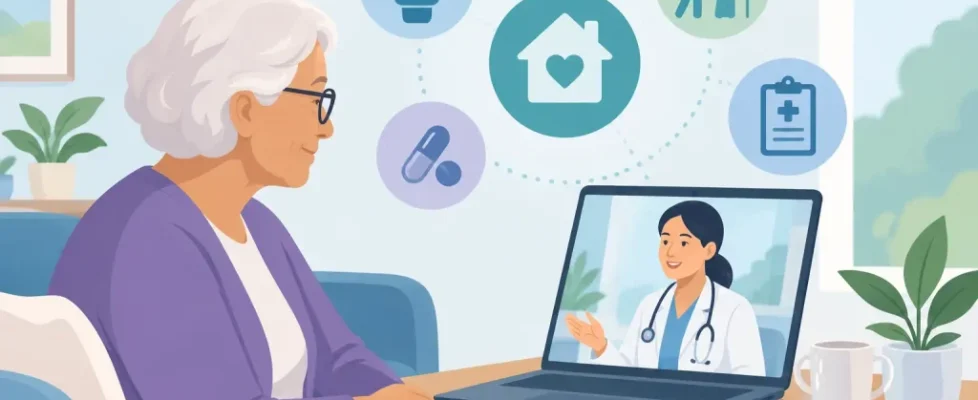
Long Term Care Telehealth Beyond the Video Visit
A resident develops new confusion after dinner. A nurse sees a subtle change from baseline, but the attending clinician is off-site and the next in-person rounding day is two days away. In that moment, long term care telehealth is not a convenience feature. It is a care-delivery capability that can determine whether the resident receives timely clinical assessment, is safely monitored overnight, or is transferred to the emergency department.
For skilled nursing facilities, assisted living communities, home health organizations, and post-acute networks, virtual care is moving beyond scheduled video visits. The more consequential models connect the right clinician to the patient, the caregiver, and clinically relevant data when decisions need to be made. That requires operational design, not simply a camera and an internet connection.
Why Long Term Care Telehealth Has a Different Job
Long-term care populations often live with multiple chronic conditions, functional limitations, cognitive impairment, polypharmacy, and a high risk of clinical deterioration. Their care also depends on a distributed team: facility nurses, medical directors, advanced practice providers, specialists, pharmacists, family caregivers, and community-based services.
A conventional video visit can be useful for routine follow-up, medication discussions, care-plan reviews, and caregiver education. But video alone may be insufficient when a clinician needs to assess respiratory effort, examine a wound, review a new rash, evaluate a change in mental status, or determine whether symptoms warrant an escalation of care.
That distinction matters. Organizations should not define long term care telehealth as a replacement for every bedside interaction. The stronger model expands access to clinical judgment between in-person encounters, supports faster triage, and gives on-site staff a practical path to bring the clinician into an assessment.
For residents and families, the benefit may be fewer disruptive transfers and more participation in care decisions. For organizations, the opportunity is better clinical coverage, more consistent workflows, and a more complete record of what was observed, assessed, and decided.
Build the Program Around High-Value Clinical Moments
The best starting point is not a broad promise to “do telehealth.” It is a focused set of care moments where delayed evaluation, travel constraints, or limited clinician availability create measurable risk.
In skilled nursing, those moments may include acute change-of-condition assessments, after-hours triage, post-hospital follow-up, behavioral health consultations, wound oversight, medication reconciliation, and chronic disease monitoring. In home-based care, they may include escalation for heart failure or COPD symptoms, medication adherence concerns, falls follow-up, and caregiver-supported assessments.
Each use case should answer three operational questions: Who identifies the need for a virtual encounter? What data must be available to the clinician? Who owns the next action after the visit?
A new symptom call, for example, should not end with an undocumented recommendation. A reliable workflow identifies the nurse or caregiver initiating the request, captures vital signs and symptom history, enables the remote exam when appropriate, documents the clinical decision, and assigns follow-up. If the resident requires in-person evaluation or emergency transfer, the same workflow should make that escalation clear.
Remote examination changes the clinical conversation
Connected examination tools can materially improve the utility of virtual encounters when staff are trained to use them correctly. Depending on the setting and clinical indication, remote examination may support review of heart and lung sounds, otoscopic images, skin findings, vital signs, and other observations that cannot be adequately assessed through a standard consumer video call.
Technology does not eliminate the clinician’s responsibility to recognize uncertainty. Image quality may be poor. A patient may be unable to participate because of delirium, hearing loss, aphasia, or cognitive decline. The on-site caregiver’s observations remain essential, particularly because they know the resident’s baseline function and behavior.
The practical goal is not to imitate every element of an in-person exam. It is to provide enough trustworthy information to make the next decision safer and faster.
Make the On-Site Team the Center of the Workflow
Long-term care telehealth succeeds or fails at the point of care. Nurses, aides, and caregivers should not be treated as passive technical assistants. They are the clinical eyes and ears who identify change, prepare the resident, collect information, operate connected devices, and carry out the care plan.
That means program leaders need to design for real shift conditions. A workflow that works during weekday business hours may fail during an overnight staffing shortage. Equipment stored in a locked office, a platform that requires multiple logins, or an encounter process that adds 20 minutes of documentation will reduce adoption quickly.
Training should be role-based and scenario-driven. Teams need practice initiating an urgent consult, positioning a camera for a wound assessment, communicating concise clinical information, troubleshooting common device issues, and documenting the result. Competency validation is particularly valuable when remote examination equipment is part of the model.
Family engagement deserves similar attention. With patient consent and appropriate privacy controls, caregivers can join selected visits to hear the plan directly, ask questions, and reinforce instructions. This can be especially valuable for residents with dementia, adults receiving home health services, and patients whose family members coordinate appointments, medications, and transportation.
Clinical Integration Must Include Data and Governance
A telehealth program becomes clinically useful when it fits into the organization’s documentation, communication, and escalation processes. Fragmented encounters create risk: a remote clinician may make a recommendation that is never visible to the primary care team, or facility staff may be unable to locate the note when symptoms worsen later in the shift.
Organizations should establish how virtual encounters are documented, where results from connected devices are stored, how orders are communicated, and who receives follow-up alerts. Integration with the electronic health record may be ideal, but an interim workflow can still be safe if it is standardized, auditable, and consistently used.
HIPAA compliance, user access controls, consent processes, and secure communication are baseline requirements, not differentiators. Leaders should also define clinical governance. This includes credentialing and privileging where applicable, coverage expectations, supervision parameters, quality review, and protocols for situations that exceed the capabilities of remote care.
A strong program makes its limits explicit. Telehealth should accelerate escalation when a resident is unstable, when an adequate assessment cannot be obtained remotely, or when in-person intervention is clearly indicated. The objective is appropriate care in the appropriate setting, not avoiding transfers at all costs.
Reimbursement Requires Discipline, Not Assumptions
Payment policy for telehealth and related virtual services continues to evolve across Medicare, Medicaid, commercial plans, and care settings. Coverage can depend on the practitioner type, patient location, service furnished, technology used, documentation, and current federal or state policy. Organizations should avoid building a model around a single billing assumption or a temporary policy extension.
Instead, clinical, compliance, finance, and operational leaders should evaluate each proposed use case together. Determine whether the service is billable under applicable rules, what documentation is required, how facility and professional workflows interact, and whether the model also creates value through avoided transfers, improved continuity, reduced travel, or better capacity management.
For many organizations, the business case is broader than a single telehealth claim. Faster access to clinicians can support quality goals, reduce avoidable disruption for frail patients, and improve staff confidence in managing complex conditions. Those benefits still need measurement.
Useful performance indicators include time from change in condition to clinical assessment, emergency department transfers, hospitalization patterns, completion of post-discharge follow-up, staff adoption, patient and family experience, and the percentage of encounters with complete documentation. Review results by facility, shift, diagnosis, and patient population. Averages can hide weak points in the workflow.
Start Narrow, Then Scale With Evidence
Organizations often overreach by launching telehealth across every service line at once. A better approach is to begin with one or two high-frequency, high-impact scenarios, establish baseline measures, and test the workflow with the people who will use it.
For example, a facility may begin with evening change-of-condition assessments supported by a nurse, a remote clinician, and connected examination capability. After evaluating response times, transfers, documentation quality, and staff feedback, the organization can refine the model before adding specialty consultations or chronic care follow-up.
The technology platform matters, but the operating model matters more. Long-term care telehealth delivers value when it helps clinicians make better decisions with better information, while respecting the realities of residents, families, and the staff who care for them every day.
The most durable programs will not be judged by how many video visits they complete. They will be judged by whether a vulnerable patient receives the right clinical attention before a manageable change becomes a crisis.