
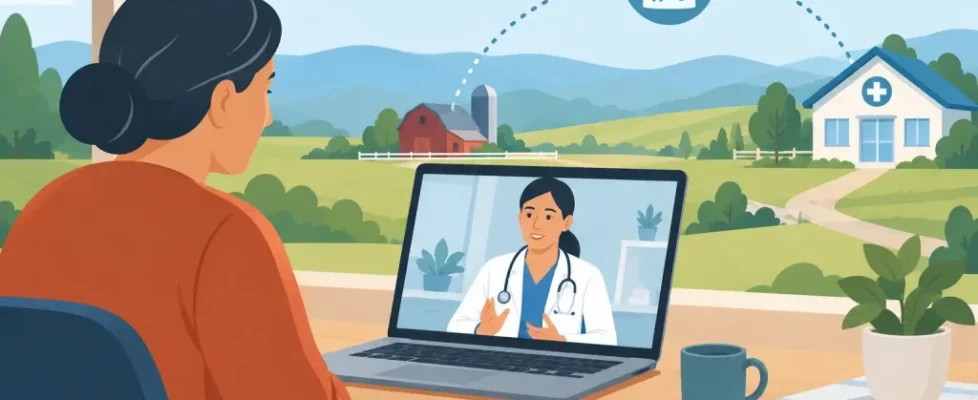
Rural Health Telemedicine That Extends Clinical Reach
A patient who drives two hours for a 15-minute medication follow-up is not facing a scheduling inconvenience. They are facing a care-access barrier that can delay treatment, disrupt work and caregiving, and make routine clinical oversight impractical. For rural health organizations, telemedicine is most valuable when it changes that equation without lowering the clinical standard.
Rural health telemedicine is not simply a video visit added to an existing schedule. It is a connected-care model that can bring clinicians, clinically relevant data, remote examination capability, caregivers, and local care teams into the same workflow. When designed around the realities of rural practice, it can extend specialty access, close follow-up gaps, and support earlier intervention for patients who might otherwise be lost between appointments.
Why rural health telemedicine requires a different model
Rural communities often face a compounding set of constraints: clinician shortages, long travel distances, limited specialty availability, weather-related disruptions, broadband variability, and high rates of chronic disease. A standard consumer video platform may address only one part of that problem – the physical distance between patient and clinician.
Clinical decisions frequently require more than conversation. A provider may need accurate vital signs, visual assessment, medication reconciliation, symptom tracking, or input from a nurse, caregiver, school professional, or community health worker who is physically with the patient. Rural telemedicine programs are stronger when they identify which elements of an in-person visit must be replicated, supported, or redesigned remotely.
This distinction matters for rural health clinics, critical access hospitals, federally qualified health centers, and community health centers. These organizations are not looking for a virtual front door alone. They need care models that protect clinician time, support documentation, account for reimbursement policy, and fit the staffing resources available at each site.
Build care around clinical use cases, not the technology
The most durable programs begin with a defined clinical access problem. A hospital may need specialist support for emergency department presentations. A rural clinic may need a practical way to manage hypertension, diabetes, behavioral health needs, or post-discharge follow-up. A pediatric practice may need to involve caregivers in a lower-stress setting for children with autism or other special healthcare needs.
The technology selection should follow that use case. A simple follow-up for a stable condition may work well through video, provided the patient can connect reliably and the clinician has the information needed for decision-making. A more complex visit may require connected devices, a trained telepresenter, remote examination tools, or a local partner site such as a school, clinic, or long-term care facility.
Remote examination changes the value proposition
Remote examination capability can make telemedicine more clinically useful than a conversation-only encounter. Depending on the service line and device availability, a clinician may be able to assess heart and lung sounds, examine ears and throat, review skin concerns, or obtain vital signs with assistance from a patient, caregiver, or trained local staff member.
That does not mean every encounter should be virtual. Telemedicine must have clear escalation paths. Chest pain, severe respiratory distress, a concerning neurologic change, or any presentation requiring hands-on intervention belongs in an appropriate in-person setting. The objective is not to replace local care. It is to make the right level of care available sooner and reduce unnecessary travel when a virtual clinical encounter is appropriate.
Designing a workflow that rural teams can sustain
The operational failure point is rarely the video connection alone. It is the work surrounding the visit: determining eligibility, scheduling the right encounter type, preparing the patient, collecting data, documenting care, coordinating referrals, and closing the loop after the appointment.
A telemedicine workflow should specify who owns each handoff. For example, front-desk staff may verify contact preferences and technology readiness; a medical assistant may collect pre-visit information and confirm device readings; a nurse may escalate concerning findings; and the clinician may determine whether the patient needs an in-person examination, testing, or emergency evaluation. Without this clarity, virtual care can create extra steps instead of reducing friction.
Organizations should also plan for the reality that patient access is uneven. Broadband limitations and digital literacy are genuine barriers, particularly for older adults, low-income households, and patients living in remote areas. Phone-based outreach, community telehealth access points, caregiver-supported visits, and device loaner programs may all be appropriate, depending on the population and local resources. Convenience should not become a new reason to exclude patients.
For pediatric care, workflow design should actively include caregivers. A virtual visit from home can reduce sensory stress and travel burden for children with complex needs, while allowing clinicians to observe routines, behaviors, or environmental factors that may not be visible in an exam room. Yet home visits also require thoughtful scheduling, privacy guidance, and realistic expectations about what can be assessed remotely.
Data, privacy, and clinical accountability
Connected care produces value only when data reaches the right person in a usable form. Continuous streams of readings without triage rules can overwhelm clinical teams. Rural organizations should establish which measurements matter, what thresholds trigger review, who responds, and how actions are documented in the medical record.
For chronic care management, this may mean using remote patient monitoring data to identify patients whose blood pressure, weight, glucose, or symptoms indicate a need for outreach. The goal is not to collect more data for its own sake. It is to create a reliable path from a patient signal to a clinical action.
HIPAA compliance, identity verification, consent processes, role-based access, and secure documentation remain foundational. So does clinical accountability. The supervising or treating clinician needs clear protocols for delegation, device use, patient education, emergency escalation, and communication with local providers. These requirements are not administrative extras. They are what make virtual care credible at scale.
Reimbursement must be designed into the program
A clinically promising service can still fail if reimbursement assumptions are vague. Payment policy for telehealth, remote patient monitoring, chronic care management, behavioral health, and facility-based services can vary by payer, setting, provider type, and state. Medicare rules, Medicaid program policies, commercial plan requirements, and rural-specific payment considerations may not align perfectly.
Leaders should evaluate reimbursement before broad deployment, but they should avoid treating it as a one-time billing exercise. Policies change, coding requirements evolve, and documentation needs differ across service lines. A program needs an accountable owner who can monitor policy updates, validate workflows with billing teams, and ensure that services delivered match the documentation and supervision requirements of the applicable benefit.
There is also a strategic trade-off. Some high-value telemedicine activities may not fit neatly into a single reimbursable encounter, especially early outreach, caregiver education, and coordination with community partners. Organizations should separate direct revenue questions from total program value, including reduced no-shows, improved retention, faster access to specialty input, avoided transfers, and better chronic disease follow-up.
Measure access and outcomes, not just visit volume
Video-visit counts are easy to report, but they do not prove that a rural telemedicine program is working. Better measures connect the model to the problem it was intended to solve. A clinic might track time to specialty appointment, missed-appointment rates, emergency department transfers, follow-up completion, blood pressure control, patient travel avoided, or clinician capacity.
Qualitative feedback also matters. Ask patients whether they could participate from a location that felt private and practical. Ask caregivers whether virtual care reduced disruption. Ask clinicians whether remote data was sufficient for decisions and where they still needed in-person support. These findings often reveal the difference between a program that is technically available and one that is genuinely accessible.
Recognized innovators in connected care increasingly focus on this clinical-operational fit. Platforms such as Dr. Miltie are designed around the broader opportunity: remote examinations, patient-provider connectivity, and clinically actionable information rather than video alone. The right solution, however, depends on the organization’s care model, staffing, patient population, and technology readiness.
Rural health telemedicine earns its place when it gives patients a credible clinical option they can actually use and gives care teams a workflow they can realistically maintain. Start with one high-friction care gap, build the escalation and documentation pathways carefully, and let measured clinical results determine where the model should expand next.