
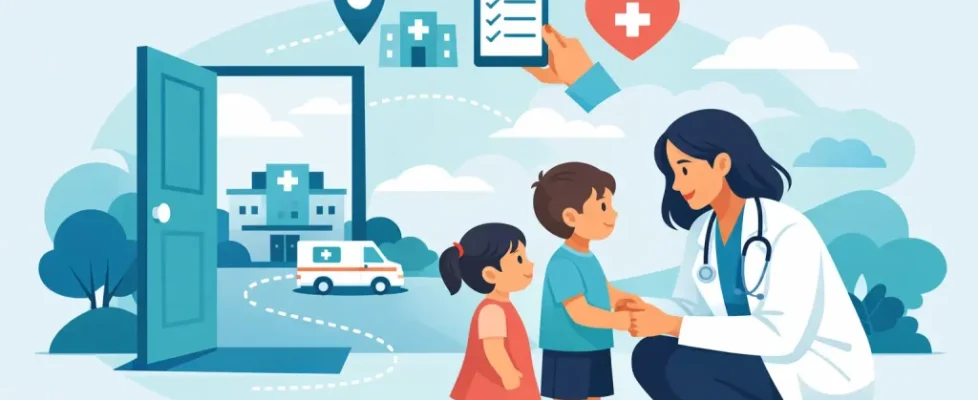
Improving Pediatric Access to Healthcare
A child with asthma misses school because the nearest pediatric specialist is two hours away. A parent delays a developmental follow-up because taking unpaid time off work means losing a shift. A rural clinic has the will to help, but not enough subspecialty coverage to keep every child on track. Improving pediatric access to healthcare starts in these operational realities, not in broad mission statements.
For healthcare leaders, access is not a single problem with a single fix. It is a stack of constraints that affect pediatric care differently than adult care. Transportation barriers, caregiver schedules, school attendance, limited pediatric subspecialty capacity, language access, behavioral health demand, and the needs of children with disabilities all shape whether care is actually available. Telehealth can change that equation, but only when it is designed as part of a clinically credible care model rather than treated as a standalone video tool.
Why improving pediatric access to healthcare is different
Pediatric access depends on at least two patients showing up – the child and the caregiver. That alone changes scheduling, consent, communication, and follow-up. It also means missed care is often tied to family logistics rather than lack of clinical need.
Children with special healthcare needs add another layer. For autistic children or those with sensory sensitivities, a crowded waiting room, unfamiliar environment, or long travel day can turn a routine appointment into a high-stress event. In those cases, access is not only about appointment availability. It is about whether the care setting supports meaningful engagement and usable clinical observation.
There is also a supply issue that health systems cannot ignore. Pediatric specialists are unevenly distributed, and the gap is more visible in rural and underserved communities. Safety-net organizations, federally qualified health centers, school-based programs, and critical access hospitals often carry substantial pediatric demand without equivalent specialty support. Any serious strategy for improving pediatric access to healthcare must address reach, triage, continuity, and workforce extension at the same time.
Telehealth works best when it solves a specific access gap
Telehealth has matured beyond the early assumption that convenience alone is enough. In pediatrics, the stronger use case is targeted access expansion. That may mean virtual follow-up after hospital discharge, developmental screening support in a primary care setting, behavioral health visits delivered to the home, or specialist consults coordinated through a community clinic closer to the family.
The most effective organizations define where virtual care adds clinical and operational value. Follow-up care is often a strong starting point because it reduces travel burden while supporting medication checks, care plan adherence, symptom review, and caregiver questions. Behavioral health is another area where telehealth can improve attendance and reduce no-shows, particularly when care can happen in a familiar environment.
For medically complex pediatric populations, remote monitoring and connected-care workflows can extend visibility between visits. That does not mean every child needs a device at home. It means organizations should identify where clinically relevant data, caregiver-reported observations, and structured check-ins can prevent deterioration or unnecessary emergency utilization. The right model depends on acuity, diagnosis, family readiness, and reimbursement conditions.
Building a pediatric access model that holds up operationally
Video availability is not the same as access. Health systems often learn this quickly when visit volume rises but continuity, documentation, and care coordination lag behind. Pediatric access improves when virtual care is built into workflows that clinicians can sustain.
Start with triage logic. Which visit types are appropriate for virtual care, which require in-person examination, and which can alternate over time? Pediatrics benefits from a deliberate hybrid model. Routine follow-ups, medication management, post-discharge check-ins, and parts of chronic disease management may transition well to virtual formats. New physical complaints, certain urgent evaluations, and visits requiring hands-on assessment may not.
Next comes caregiver engagement. Pediatric telehealth succeeds when instructions are clear, scheduling windows are realistic, and families understand what will happen during the visit. If a caregiver needs to help with symptom history, camera positioning, device setup, or remote exam support, the organization should plan for that explicitly. Otherwise, the technology may technically function while the clinical encounter underperforms.
Documentation and escalation pathways matter just as much. A virtual pediatric visit must lead cleanly to orders, referrals, care plans, and in-person escalation when needed. This is where many fragmented programs stall. The access gain from telehealth can disappear if families still have to navigate disconnected next steps on their own.
Where telehealth can expand pediatric reach fastest
Not every pediatric service line will see the same return from virtual care, but several areas consistently show practical value.
Behavioral health is a clear example. Child and adolescent psychiatry remains constrained in many markets, and telehealth can extend limited specialist capacity across broader geographies. It can also reduce friction for follow-up, caregiver participation, and school-day scheduling.
Developmental and neurobehavioral care is another promising area, especially when clinicians need to observe children in lower-stress environments. Home-based or community-based virtual visits may reveal more representative communication, behavior, and functional patterns than an unfamiliar clinic setting. That does not replace in-person assessment across the board, but it can improve access to screening, follow-up, coaching, and care coordination.
Chronic disease management also benefits from connected care. Asthma, diabetes, epilepsy, and complex pediatric care plans often require more touchpoints than traditional scheduling supports. Virtual follow-up, symptom tracking, caregiver education, and remote review of clinically relevant data can help organizations intervene earlier and reduce gaps between appointments.
School-linked care deserves more attention as well. When telehealth is coordinated through schools or community clinics, organizations can reach children who would otherwise miss preventive, behavioral, or low-acuity follow-up services. This model requires careful privacy, consent, and workflow planning, but the access upside is substantial.
The trade-offs leaders need to face directly
Telehealth is not a universal substitute for in-person pediatrics, and treating it that way creates risk. Some conditions require physical examination, diagnostic testing, or procedural care that cannot be replicated remotely. Younger children may have limited tolerance for virtual interaction. Certain families may lack broadband access, device access, digital confidence, or private space for a visit.
That is why digital equity cannot be treated as a side issue. If an organization expands telehealth without addressing language support, tech onboarding, interpreter integration, and low-bandwidth options, it may widen disparities rather than reduce them. Improving access sometimes means using telehealth selectively while strengthening in-person pathways, mobile outreach, or community-based partnerships in parallel.
Reimbursement also remains a practical variable. Payment policy for pediatric telehealth can support expansion, but organizations still need service-line discipline around coding, documentation, and eligible use cases. Financial sustainability matters because access programs that cannot be operationalized or reimbursed tend to fade after pilot enthusiasm wears off.
What healthcare organizations should measure
If pediatric access is the goal, utilization alone is not enough. More virtual visits do not automatically mean better access. Leaders need to track whether telehealth changes time to appointment, no-show rates, caregiver participation, specialist reach, continuity after discharge, and follow-up completion.
Clinical measures should sit alongside operational ones. Depending on the population, that may include emergency department utilization, medication adherence, symptom control, avoidable transfers, or chronic care management performance. Family experience is also a real indicator, especially in pediatrics where caregiver burden can determine whether care plans are realistic.
The strongest programs measure what happens before and after the virtual visit, not just during it. That includes referral closure, escalation speed, documentation quality, and the capture of clinically relevant data that can support ongoing management. This is where connected-care strategies become more valuable than basic teleconferencing.
A better path to improving pediatric access to healthcare
The organizations making real progress are not asking whether telehealth can replace pediatric care. They are asking where virtual care, remote examination support, monitoring, and community-based workflows can remove the friction that keeps children from getting timely care in the first place.
For some systems, that starts with pediatric behavioral health. For others, it is specialty follow-up, school-connected care, or support for children with complex needs in the home. The right answer depends on geography, provider capacity, reimbursement realities, and the patient population being served. But the strategic direction is clear: access improves when care moves closer to the child without losing clinical integrity.
That is the standard worth building toward – not more technology for its own sake, but pediatric care models that reach families earlier, fit real life better, and give clinicians the tools to act before access barriers become health setbacks.