
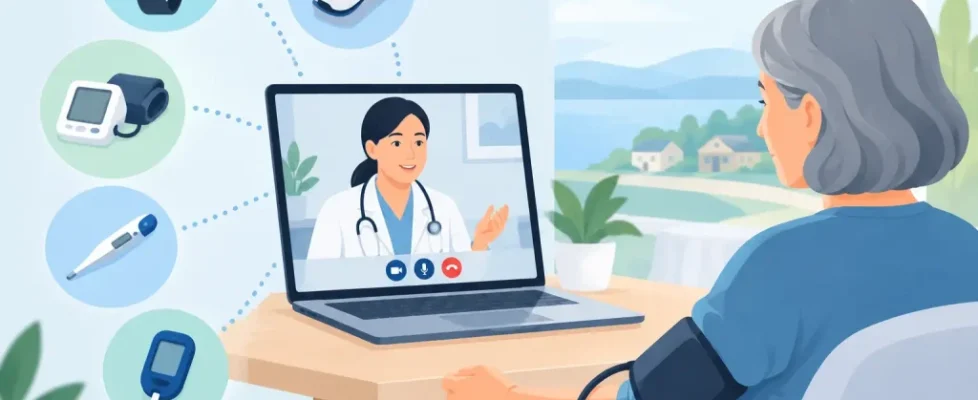
Telehealth Devices That Extend Clinical Reach
A video visit can establish rapport, review symptoms, and guide a care plan. It cannot, by itself, provide a lung sound, a tympanic image, a pulse-oximetry trend, or a reliable home blood pressure reading. Telehealth devices close that clinical gap by bringing relevant examination and monitoring data into virtual care encounters.
For healthcare organizations, the question is not whether connected devices are innovative. The operational question is whether the device produces clinically usable data, fits the patient’s environment, reaches the right member of the care team, and supports a reimbursable workflow. The answer varies by population, service line, and care model.
What Telehealth Devices Actually Do
Telehealth devices are connected clinical tools used to capture, transmit, or support health information outside a traditional exam room. They range from patient-facing monitoring equipment to clinician-operated peripherals used during a remote examination. The most effective programs treat them as components of care delivery, not as isolated technology purchases.
A connected blood pressure cuff, weight scale, pulse oximeter, glucometer, or wearable can support remote patient monitoring when readings are collected and reviewed according to an established care plan. These tools are especially useful in hypertension, heart failure, diabetes, pulmonary disease, and post-discharge follow-up, where change over time can matter as much as a single reading.
Remote examination devices serve a different purpose. Digital stethoscopes, otoscopes, dermatoscopes, examination cameras, and multi-function examination tools can extend a clinician’s ability to assess a patient during a live virtual encounter. In a school, rural clinic, long-term care facility, or home visit supported by a trained caregiver, these tools can turn a conversation into a more clinically informed assessment.
The distinction matters. Monitoring devices generate longitudinal data between encounters. Examination devices help clinicians make decisions during an encounter. Some care models need both, but organizations should avoid buying a broad device catalog before defining the clinical problem each tool is expected to solve.
Start With the Care Model, Not the Device List
A common implementation mistake is selecting a device because it has impressive specifications, then trying to create a workflow around it. Clinical leaders should begin with a narrow use case: reducing avoidable readmissions after heart failure discharge, improving asthma follow-up for children, extending specialist access to rural sites, or strengthening chronic disease outreach for patients who struggle to travel.
From there, define what decision the data will support. A home scale may help identify early fluid retention only if there is a threshold, an escalation pathway, and a clinician or care manager assigned to act. A digital otoscope may improve pediatric ear complaints only if the image quality is sufficient and the person handling the device can capture the view consistently.
This approach also prevents a false choice between high-tech and high-touch care. Devices can increase the frequency and quality of clinical information, but they do not replace judgment, coaching, or relationship-based follow-up. A patient with repeated abnormal readings may need medication adjustment, education, transportation support, or an in-person exam. The device identifies a need; the care model determines what happens next.
Match the device to the care setting
Home deployment prioritizes simplicity, connectivity, and patient instruction. A device with multiple screens, charging requirements, or complex pairing may perform well in a clinic and fail in a patient’s kitchen. Cellular-enabled options can reduce reliance on home broadband, although they may increase program costs and require coverage validation in remote areas.
Clinic, school, and facility deployments can support more sophisticated exam peripherals because a nurse, medical assistant, caregiver, or telepresenter may be available to help. These settings benefit from clear role definitions: who prepares the patient, operates the device, documents findings, disinfects equipment, and assists when a virtual visit becomes an in-person escalation.
For pediatric patients, the setting can be decisive. Many autistic children and children with special healthcare needs tolerate assessment more successfully in a familiar environment with a trusted caregiver nearby. A remote exam still requires clinical rigor, but reducing sensory stress, travel time, and unfamiliar waiting rooms may improve the likelihood that follow-up actually occurs.
Clinical Quality Is More Than Connectivity
A reading that arrives in a dashboard is not automatically reliable. Procurement and clinical governance teams should evaluate accuracy, intended use, validation status, measurement technique, image or audio fidelity, and the conditions under which a device can be used safely.
Blood pressure is a familiar example. Cuff size, body position, rest period, and repeat measurements influence the result. If an RPM program distributes cuffs without teaching patients how and when to measure, the organization may generate noisy data and unnecessary alerts. The same principle applies to pulse oximetry, glucose readings, weights, and respiratory assessment tools.
For remote examinations, quality includes the human process around the device. Can a staff member obtain an adequate ear image? Can the clinician see and hear the output in real time? Is there a repeatable process when the image is unclear? These questions should be tested with the actual patient population, lighting, bandwidth, staffing model, and physical environment, not only in a vendor demonstration.
Build the Workflow Before Scaling Enrollment
Telehealth device programs often stall at the point where data reaches the organization. A successful pilot can become unmanageable when hundreds of readings arrive daily without triage rules or staffing capacity. Clinical relevance must be designed into the workflow.
Organizations need a defined intake process, alert thresholds, review cadence, documentation standards, escalation protocols, and patient communication pathway. Not every out-of-range value is urgent, and not every normal value requires staff review. The appropriate model depends on diagnosis, acuity, medication regimen, risk factors, and the clinical team’s scope of practice.
Integration also deserves early attention. Device data should be available where clinicians work whenever feasible, with clear provenance and a practical way to distinguish patient-generated information from data captured in a supervised setting. Full electronic health record integration may be appropriate for mature programs, but it is not the only path to value. What matters first is that information reaches an accountable clinician or care team member in time to influence care.
Patient onboarding is equally operational. Teams should verify that the patient can use the device, explain what readings mean and do not mean, confirm contact preferences, and establish what to do if symptoms worsen. Shipping a device is not enrollment. A short live training session, teach-back, and early follow-up can prevent attrition and improve data quality.
Privacy, Equity, and Reimbursement Belong in the Design
HIPAA compliance is foundational, but privacy planning should go beyond a business associate agreement. Organizations should understand what data is collected, where it is stored, who can access it, how devices are reassigned or wiped, and how patients receive clear consent and support. Shared devices in schools, community sites, and long-term care facilities require particularly disciplined processes.
Equity considerations are just as practical. A program that assumes a smartphone, reliable broadband, English-only instructions, and confidence with digital tools can unintentionally exclude people with the greatest access barriers. Device choice, interpreter services, caregiver engagement, cellular connectivity, accessible instructions, and alternative pathways should be part of implementation planning.
Reimbursement policy should be evaluated alongside clinical design, not after launch. Coverage, eligible practitioners, documentation requirements, device requirements, and payer rules differ by program type and may change. Medicare, Medicaid, and commercial payer policies do not always align. Compliance and revenue-cycle leaders should validate the current requirements for remote patient monitoring, chronic care management, virtual visits, and related services before setting volume or financial assumptions.
Measure Whether the Program Changes Care
Device distribution is not a meaningful outcome. Healthcare leaders should measure adoption, successful data transmission, response time to clinically significant alerts, completion of planned follow-up, patient experience, clinician workload, utilization patterns, and outcomes relevant to the target condition.
For a rural health clinic, success may be fewer miles traveled for specialty follow-up and faster access to a remote examination. For a safety-net organization, it may be sustained engagement among patients with poorly controlled hypertension. For a pediatric program, it may be reduced missed appointments and better caregiver participation. The right measures reflect the original care problem, not the number of devices purchased.
Telehealth devices are most valuable when they make care more observant, more responsive, and more reachable without creating a new layer of administrative burden. Start with a clinical decision that needs better information, build the human workflow around it, and let the technology earn its place in care.