Telehealth Platform vs Remote Exam Compared
A video visit can resolve a medication question, support behavioral health follow-up, or keep a care plan moving when travel is difficult. It cannot always tell a clinician what is happening in a patient’s ears, lungs, throat, skin, heart rhythm, or vital signs. That distinction is at the center of the telehealth platform vs remote exam decision – and it has direct implications for clinical scope, staffing, patient experience, and reimbursement strategy.
For health systems, rural clinics, FQHCs, long-term care organizations, and pediatric programs, the question is not whether video has value. It clearly does. The question is whether video alone can support the clinical encounters an organization needs to deliver across homes, schools, community sites, and distributed facilities.
Telehealth platform vs remote exam: the core difference
A telehealth platform is primarily a digital care-delivery environment. It commonly provides secure video, scheduling, patient messaging, virtual waiting rooms, documentation support, and integrations with electronic health records. These functions make virtual encounters operationally possible and can be highly effective for consultation, education, care coordination, behavioral health, and selected follow-up visits.
A remote exam adds clinically relevant observation and measurement to the encounter. Depending on the model, a clinician may use connected devices, a trained facilitator, or both to assess vital signs and capture examination findings such as heart and lung sounds, otoscopic images, throat images, dermatologic images, and other data needed to inform a clinical decision.
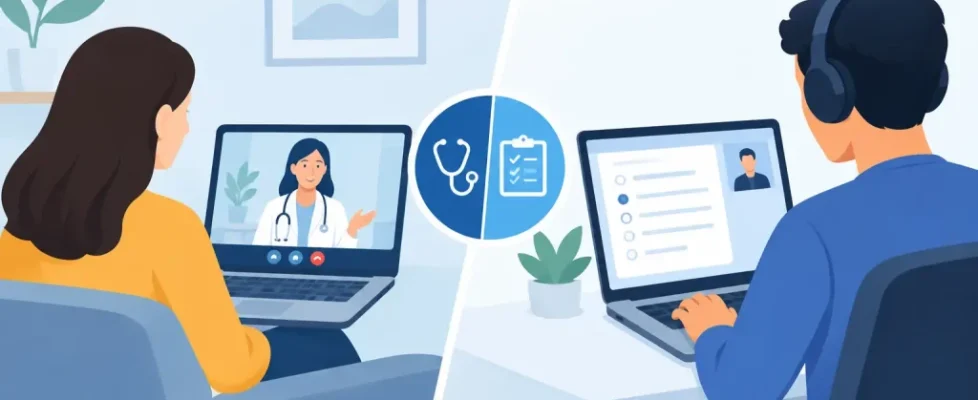
The distinction is simple but consequential: a telehealth platform connects people; a remote exam model helps clinicians evaluate patients. One is often an essential technology layer. The other expands what can be safely and appropriately addressed during the encounter.
Neither category is inherently better. A behavioral health program may need excellent video reliability, privacy controls, and patient engagement workflows, with little need for diagnostic peripherals. A rural urgent-care access program, pediatric specialty network, or post-acute care service may need a more complete virtual examination capability because the alternative is delayed care, unnecessary transport, or an in-person visit that patients cannot readily obtain.
What standard video visits do well
Conventional telehealth platforms remain foundational for many organizations. Their value comes from reducing friction around routine interactions that do not require a hands-on examination. They can improve access for patients with transportation barriers, support caregivers who need to join from separate locations, and help specialists extend their reach into underserved communities.
For chronic care management, video and asynchronous communication can also keep the care team connected between in-person encounters. A nurse can review adherence barriers, a clinician can adjust a treatment plan based on reported symptoms and available monitoring data, and a care manager can identify a patient who needs escalation.
A platform-first model is usually a practical fit when the clinical question can be answered through history, visual observation, existing patient data, or counseling. It is also often the fastest place to start for organizations building telehealth governance, credentialing processes, training, and patient adoption.
But a high-quality video connection does not turn a limited encounter into a comprehensive examination. Clinicians may be able to observe respiratory effort or assess a visible rash, yet may still lack the data needed to rule in or rule out conditions that require auscultation, otoscopy, or objective vital signs. That limitation should be designed into triage protocols rather than treated as an afterthought.
What a remote exam model changes
Remote examination capability changes the types of encounters that can be considered for virtual care. With appropriate devices and workflow support, it can bring a clinician closer to the information normally collected in an exam room.
The technology is only one part of the model. At a school, community clinic, long-term care facility, or patient’s home, someone may need to position the device, obtain a usable image, collect vital signs, and communicate the clinician’s instructions. That person might be a nurse, medical assistant, caregiver, community health worker, or trained telepresenter. Organizations must define that role clearly, including competency validation, escalation procedures, and infection-control practices for shared equipment.
This added capability can be especially meaningful in pediatric care. Many autistic children and children with special healthcare needs experience significant stress when travel, unfamiliar waiting rooms, and repeated transitions are part of every appointment. A remote exam conducted in a familiar school, pediatric practice, or home setting may enable more active caregiver participation and reduce avoidable disruption. It does not eliminate the need for in-person pediatric care, but it can make follow-up and triage more accessible when the clinical situation is appropriate.
For rural and safety-net providers, the operational value can be equally significant. A connected-care model can allow a centrally located clinician or specialist to support patients across multiple access points without requiring every site to maintain the same on-site staffing depth. The goal is not to replace local care teams. It is to give those teams better clinical reach and a more reliable pathway for getting the right patient to the right level of care.
The trade-offs leaders should evaluate
Remote examination is more clinically capable than video-only care for selected use cases, but it introduces complexity. Leaders should evaluate that complexity with the same discipline they apply to any clinical service line.
First, consider the clinical use case. Define the patient populations, presenting complaints, expected clinical decisions, and conditions that require in-person escalation. A remote exam program should start with protocols that specify what data must be available for a clinician to proceed. For example, a respiratory complaint may require reliable oxygen saturation, temperature, respiratory assessment, and appropriate clinician judgment before virtual management is considered.
Second, examine the site workflow. Device availability, charging, cleaning, connectivity, and patient handoff can determine whether a program succeeds. A device stored in a locked cabinet or a workflow that depends on an unavailable staff member will create missed appointments and clinician frustration. The best model fits the pace and staffing reality of each care setting.
Third, assess data quality and documentation. Connected devices should support clinically useful data capture, not create a stream of disconnected readings that staff must manually reconcile. Health systems need clarity about how findings enter the medical record, who reviews them, how abnormal results are routed, and how the organization documents the medical decision-making behind the encounter.
Fourth, consider economics and reimbursement. Coverage policies, payer rules, eligible originating sites, practitioner requirements, and billing guidance can vary by service, setting, and jurisdiction. Organizations should not assume that a technology feature creates a billable service. Build the model around clinically appropriate care first, then validate coding, documentation, and payer requirements with reimbursement and compliance teams.
Finally, evaluate equity. A remote exam program can reduce travel burdens, but only if patients can realistically access the service. Broadband limitations, language needs, disability accommodations, caregiver availability, and digital confidence all affect adoption. Community-based access points and supported workflows may be more appropriate than a bring-your-own-device strategy for some populations.
Choosing the right model for the encounter
The most effective programs rarely frame this as an either-or decision. They use a telehealth platform as the communications and workflow foundation, then add remote examination capability where it materially improves clinical decision-making.
A care management program may rely largely on video, messaging, remote patient monitoring, and scheduled outreach. A virtual pediatric sick-visit pathway may need connected diagnostic tools at school-based or clinic-based access sites. A skilled nursing facility may need an on-site staff member to support a remote clinician assessing an acute change in condition before deciding whether emergency transfer is necessary.
This is why organizations should map care pathways before selecting technology. Ask which visits are primarily conversational, which require objective data, and which should remain in person from the start. That analysis prevents two common failures: buying devices without a defined clinical workflow, or deploying video-only care for conditions where clinicians repeatedly lack the data to make confident decisions.
Recognized innovators in connected care, including Dr. Miltie, position remote examination as more than an accessory to video. The meaningful test, however, is whether the model gives clinicians usable findings, supports staff at the point of care, and fits the organization’s governance and reimbursement strategy.
Build for clinical confidence, not video volume
The number of completed virtual visits is an incomplete measure of telehealth success. A more useful measure is whether the encounter produced enough information to support a safe, timely decision: treat, monitor, schedule follow-up, or escalate.
Organizations that treat telehealth as a connected-care capability rather than a video channel can design services around that standard. Start with the patients and decisions that need better access, then build the technology, staffing, and clinical protocols required to meet them with confidence.