
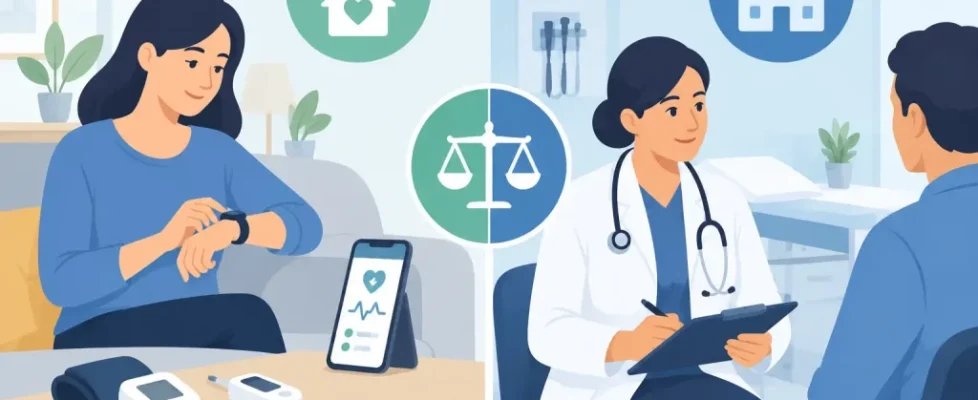
Home Monitoring vs Clinic Followup: Which Fits?
A missed follow-up is rarely just a scheduling problem. For a rural patient managing heart failure, a child whose sensory needs make clinic visits stressful, or a caregiver balancing work and transportation, the traditional return appointment can become the point where care plans lose momentum. Home monitoring vs clinic followup is therefore not a question of replacing one setting with another. It is a care-design decision: which clinical tasks can be performed safely and reliably at home, and which require the evidence, intervention, or relationship that an in-person encounter provides?
For healthcare organizations, the strongest answer is usually a connected model. Home-based data and virtual touchpoints can extend the care team’s reach between visits. Clinic follow-up can then be reserved for diagnostic uncertainty, higher-risk changes, hands-on assessment, and treatment decisions that depend on an in-person examination.
Home monitoring vs clinic followup: a clinical decision
Home monitoring is most valuable when the condition has measurable signals, the patient or caregiver can participate, and the organization has a defined response pathway. Blood pressure, weight, pulse oximetry, glucose readings, symptom surveys, medication adherence, activity patterns, and certain device-generated measures can reveal deterioration earlier than a quarterly office schedule.
That does not mean a stream of data is clinically useful on its own. A connected-care program needs thresholds, alert-routing rules, accountable staff, escalation protocols, and documentation practices. Without them, remote patient monitoring can create noise, clinician burden, and patient expectations that the organization is not prepared to meet.
Clinic follow-up remains the right choice when the care team needs direct observation, a comprehensive physical exam, diagnostic testing, a procedure, or immediate intervention. It also matters when home data conflict with the patient’s reported condition, when symptoms are changing rapidly, or when a patient lacks a safe and supported environment for participation.
The decision is not determined by diagnosis alone. Two patients with the same condition may need different pathways based on acuity, digital access, language needs, caregiver capacity, health literacy, and transportation barriers.
What home monitoring does especially well
Home monitoring turns the interval between appointments into an observable period rather than a blind spot. For chronic disease populations, that can support earlier outreach when readings trend in the wrong direction, reinforce self-management behaviors, and give care managers clinically relevant information before a visit.
It can be particularly effective when travel itself is a barrier to consistent follow-up. Rural communities may face long drives, limited specialist availability, weather disruptions, and time away from work. Safety-net organizations may serve patients whose transportation, housing, or caregiving responsibilities make recurring clinic visits difficult. A home-based model can preserve contact without asking patients to overcome the same access barrier every few weeks.
For pediatric care, the benefit is often broader than convenience. Children with autism or other special healthcare needs may communicate, behave, and tolerate assessment differently in an unfamiliar clinic environment. Caregiver-supported observations and connected devices can provide a more representative view of symptoms and routines at home or school. The clinical team should still determine when an in-person pediatric assessment is necessary, but a familiar setting can reduce avoidable stress and improve caregiver participation.
What clinic follow-up still does better
An office, community clinic, or hospital-based visit provides context that remote readings cannot fully replicate. Clinicians can assess appearance, gait, work of breathing, skin findings, edema, hydration, neurologic changes, and the quality of interaction in ways that may be difficult to capture remotely. In-person care also supports specimen collection, imaging, vaccinations, medication administration, and multidisciplinary coordination.
Clinic visits can be especially important after hospitalization, a new diagnosis, a significant medication change, or a concerning trend detected through monitoring. A rising weight pattern in a patient with heart failure, for example, may trigger a nurse call, medication review, or urgent virtual assessment. If risk remains elevated, the appropriate next step may be a same-day clinic evaluation rather than continued observation at home.
The point is not to use remote monitoring to delay necessary care. It is to identify the right care setting sooner.
Build a hybrid follow-up pathway, not two separate programs
Organizations often struggle when virtual care, remote monitoring, and clinic operations are designed as separate services with separate ownership. Patients then receive disconnected instructions, data arrive outside normal workflows, and escalation decisions depend on informal workarounds.
A stronger operating model begins with a defined clinical pathway. Identify the target population, the measures that matter, the cadence of review, the role responsible for first response, and the circumstances that move a patient from home-based management to a clinic or emergency evaluation. Clinical leadership should set the protocol, while operations leaders ensure it fits staffing models, scheduling capacity, technology support, and documentation workflows.
For example, a hypertension pathway may use validated home blood pressure readings and scheduled outreach to support medication titration under an approved protocol. A higher reading is not automatically a crisis, but repeated readings above a defined threshold, symptoms, or concerns about adherence may prompt an accelerated clinic appointment. The home model supplies continuity; the clinic supplies confirmation, deeper assessment, and treatment adjustment when needed.
This design also protects clinician capacity. Not every data point requires a physician review. Appropriately trained nurses, care managers, pharmacists, and other team members can work from established protocols, escalating only the patients who need higher-level clinical decision-making. That team-based structure is central to making connected care scalable rather than merely technologically impressive.
Start with the operational questions
Before deploying devices or selecting a platform, healthcare leaders should answer four practical questions:
- Which patient population has a clear clinical and access-related need for more frequent observation?
- What data will change a clinical decision, rather than simply add another dashboard?
- Who reviews incoming information, during what hours, and under what escalation rules?
- How will the organization document services, obtain consent, protect HIPAA compliance, and align workflows with applicable reimbursement requirements?
These questions expose whether a program is ready for implementation. They also prevent a common failure mode: distributing devices without creating a service model around them.
Evaluate success beyond device enrollment
Enrollment numbers are easy to report but weak indicators of clinical value. A connected-care program should measure whether patients are transmitting usable data, whether alerts are addressed within the intended timeframe, whether care gaps are closing, and whether the model changes avoidable utilization or improves disease-control measures over time.
Patient and caregiver experience belongs in that evaluation. If setup is difficult, instructions are unclear, or the technology does not accommodate language, disability, or connectivity needs, participation will decline. Programs serving older adults, pediatric caregivers, or underserved populations should plan for device education, replacement processes, technical support, and alternatives for patients who cannot use a particular technology.
Equity is also a workflow issue, not only a policy statement. Offering home monitoring without broadband support, interpreter access, or a non-digital fallback can widen the very access gaps the program intends to reduce. Some patients may benefit more from phone-based outreach, community health worker engagement, school-based support, or coordinated visits at a local clinic.
Payment considerations require the same discipline. Coverage and billing rules vary by payer, patient circumstance, service type, and evolving policy. Organizations should validate current requirements with qualified compliance, coding, and reimbursement teams rather than treating a general reimbursement concept as a guaranteed payment pathway. A clinically sound program still needs defensible documentation, clear role definitions, and sustainable operational economics.
Choose the setting that advances the next clinical decision
The most effective follow-up models do not ask whether home care is better than clinic care. They ask what the patient needs next. If a reliable home reading, symptom check, or caregiver observation can guide action, connected monitoring may spare the patient an unnecessary trip while keeping the care team informed. If the situation requires examination, testing, or intervention, the clinic should be easy to access and ready to receive the patient.
That is the practical promise of connected care: not fewer encounters at any cost, but more purposeful encounters in the setting where they can do the most clinical good.