
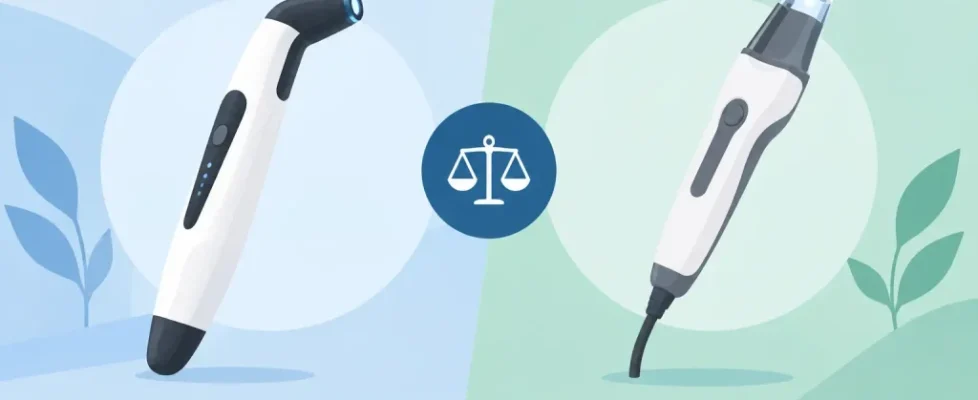
Dr. Miltie N9+ vs. MedWand: Which Fits Care?
A video visit can establish rapport, review symptoms, and guide many follow-up decisions. It cannot, by itself, provide lung sounds, a clear view of an ear canal, or clinically useful examination data from a distributed care setting. That is the central question in a Dr. Miltie N9+ vs. MedWand evaluation: which approach best extends the clinician’s exam beyond the screen while fitting the organization’s actual care model?
For hospitals, rural health clinics, federally qualified health centers, long-term care providers, and home-based care organizations, the answer should not rest on a feature checklist alone. A connected examination device is part of a clinical workflow. Its value depends on the exam modalities required, who will operate it, where the patient is located, how data reaches the clinician, and whether the resulting encounter supports a documented, reimbursable care process.
Dr. Miltie N9+ vs. MedWand: Start With the Care Model
Both Dr. Miltie N9+ and MedWand are intended to address a familiar limitation of conventional telehealth: the lack of hands-on clinical information. Each can support more informed virtual encounters than video-only care when deployed appropriately. The more useful distinction is not simply device versus device. It is whether the solution supports a repeatable model for remote examination, patient engagement, monitoring, and follow-up.
Organizations should first define the clinical moment they need to improve. A school-based pediatric program may need to help a remote clinician assess an acute concern with a trained staff member present. A critical access hospital may need specialist reach into an affiliated clinic. A home health agency may need a practical way to escalate changes in a patient’s condition before they become an emergency department visit. These are different workflows, with different expectations for training, connectivity, data capture, scheduling, and clinical oversight.
Dr. Miltie N9+ should be evaluated as part of a broader connected-care strategy, particularly where an organization wants remote examination capability to support longitudinal patient engagement and distributed care delivery. MedWand should be evaluated according to its specific examination capabilities, deployment requirements, software environment, and fit with the organization’s existing virtual-care stack. Neither device eliminates the need for clinical protocols, escalation criteria, and appropriate clinician judgment.
Remote Examination Capability Is Only the First Test
The first procurement question is straightforward: what examination inputs can the program use clinically? Buyers should request current documentation for each device’s supported modalities, image and sound quality, connectivity method, intended users, cleaning requirements, accessories, and any applicable regulatory status. Product configurations can change, so assumptions based on older demonstrations or marketing materials are not sufficient for a purchasing decision.
For a remote exam to be useful, the clinician must be able to obtain information that is clear enough to influence care. That includes more than the technical presence of a camera or sensor. It includes usability at the point of care, repeatability between users, and a clinician-facing experience that does not create unnecessary friction during a time-sensitive visit.
A device may be clinically appropriate in one setting and poorly suited to another. For example, a trained nurse in a community clinic can support a more structured remote exam than an untrained patient alone at home. Conversely, a home-based program may prioritize guidance, portability, and a simple patient or caregiver experience over a broad examination workflow. The right choice depends on whether the model is clinician-assisted, caregiver-assisted, or patient self-operated.
Pediatric and special-needs workflows require a lower-burden design
For pediatric patients, particularly autistic children and children with special healthcare needs, the examination environment can matter as much as the technology. A device that works well in a familiar home, school, or pediatric practice may reduce travel, sensory stress, missed school, and caregiver disruption. But a lower-stress setting does not mean a lower standard of clinical workflow.
Programs should determine who will prepare the child, operate the device, communicate with the remote clinician, and respond if the exam indicates a need for in-person evaluation. Short, guided exam sequences and clear caregiver instructions can be more valuable than an extensive technical feature set that is difficult to use consistently. A successful pediatric program also needs consent processes, privacy safeguards, and escalation pathways that families understand.
Workflow and Data Architecture Determine Scale
A device can perform well in a pilot and still fail to scale if its workflow sits outside the organization’s clinical systems. This is where healthcare leaders should look beyond the remote examination encounter itself.
Ask how the platform supports patient identity, appointment workflows, clinician access, documentation, and retention of clinically relevant data. Determine whether findings can be incorporated into the electronic health record through available integration approaches or documented without excessive manual steps. Review whether care teams can retrieve exam information during a follow-up encounter, not merely during a live video session.
Dr. Miltie N9+ may be particularly compelling for organizations looking beyond episodic virtual visits toward connected care, chronic care management, and recurring engagement across distributed populations. That broader ambition should be tested in a workflow demonstration using the organization’s own scenarios. A strong demonstration includes the beginning and end of the care process: enrollment, device preparation, live exam, documentation, clinician decision-making, follow-up, and escalation.
MedWand may be a practical fit when the organization has already standardized on a virtual-care platform and needs to assess how a remote examination device can operate within that environment. In that case, interoperability and operational ownership become decisive. A clinical team should know where the device is stored, who maintains it, what happens when it needs replacement, and how support is handled when a patient or site cannot connect.
Security, privacy, and governance are operational requirements
HIPAA compliance is not a label to apply after implementation. Healthcare organizations should evaluate the full handling of protected health information, including account management, access controls, data transmission, audit capabilities, business associate arrangements where applicable, and processes for lost or damaged devices.
Governance also includes clinical accountability. Define which staff roles may facilitate an exam, what training they require, when a clinician must be present remotely, and which findings require in-person escalation. For multi-site systems, standardizing these rules prevents one clinic or facility from creating a materially different care experience than another.
Compare the Total Operating Model, Not Unit Price
A lower device price can be outweighed quickly by staff burden, recurring software costs, fragmented documentation, replacement needs, or poor adoption. Conversely, a more capable connected-care model may justify its investment if it reduces avoidable travel, speeds access to clinical decisions, supports earlier intervention, or allows scarce specialists to extend their reach.
A disciplined evaluation should model the total operating cost across the intended population. Include hardware, subscriptions, implementation, training, technical support, infection-control supplies where relevant, connectivity, integration work, staff time, and replacement planning. Then estimate the measurable care impact: avoided transfers, completed follow-ups, reduced no-shows, time to clinical assessment, patient and caregiver satisfaction, and clinician adoption.
Reimbursement deserves the same practical approach. Remote examination technology does not independently create billable services. Payment depends on the services delivered, eligible professionals, documentation, payer rules, site-of-care requirements, and applicable federal and state policy. Programs should involve compliance, revenue cycle, and clinical leadership early so that care design and documentation support the intended reimbursement pathway rather than trying to retrofit it later.
Questions That Separate a Pilot From a Program
Before choosing between Dr. Miltie N9+ and MedWand, require each vendor to demonstrate the workflow with realistic users and conditions. Test the device on the network available in a rural clinic, long-term care facility, school, or patient home. Have the individuals who will actually operate it complete an exam while a clinician assesses the quality and usability of the information received.
The most revealing questions are practical. Can a caregiver use the device after brief instruction? Can a nurse complete the remote exam without extending the visit beyond a reasonable duration? Can the clinician document findings efficiently? What happens if audio, image quality, or connectivity is inadequate? How does the organization know whether the program is improving access or merely adding another technology layer?
A limited pilot should have explicit success measures and a defined decision point. Track completed examinations, technical failure rates, clinician confidence in the data, escalation outcomes, patient experience, staff time, and financial performance. These measures expose whether the technology is supporting care delivery or simply producing impressive demonstrations.
The Better Choice Is the One Clinicians Will Use
There is no universal winner in a Dr. Miltie N9+ vs. MedWand comparison. MedWand may suit organizations seeking a particular remote examination device within an established virtual-care environment. Dr. Miltie N9+ may be the stronger strategic fit for organizations building a more comprehensive model that connects remote exams with ongoing engagement, monitoring, and distributed care workflows.
The decisive factor is clinical adoption. Select the option that gives clinicians usable information, gives patients and caregivers a manageable experience, and gives operations leaders a process that can be governed, measured, and sustained. The next productive step is not another feature comparison. It is a real-world workflow test with the patients, staff, connectivity, and care decisions the program must support.