Remote Patient Monitoring Systems That Scale
When a patient with heart failure is discharged on Friday, the real test of care continuity starts on Saturday. That is where remote patient monitoring systems move from concept to operational necessity. For hospitals, physician groups, FQHCs, post-acute providers, and payer-aligned programs, these systems are no longer just a way to collect vital signs at home. They are becoming a core layer of care delivery that supports earlier intervention, broader clinical reach, and stronger alignment with reimbursement.
The organizations seeing the most value are not treating remote monitoring as a stand-alone device program. They are using it as part of a connected care model – one that links patient-generated data, remote clinical workflows, virtual exams, and care management into a practical, billable, scalable service line.
What remote patient monitoring systems actually need to do
Many healthcare leaders begin with a simple question: what counts as a remote patient monitoring system in a real-world clinical environment? The answer is broader than a blood pressure cuff paired to an app.
A viable system has to collect clinically relevant data from outside the traditional point of care, transmit that data securely, and make it actionable for care teams. It also needs to fit how providers actually work. If the data arrives without context, if escalations are unclear, or if reimbursement is an afterthought, adoption usually stalls.
For that reason, the strongest systems combine three functions. First, they capture patient data consistently across home, facility, school, workplace, or community settings. Second, they support clinical decision-making through alerts, documentation workflows, and longitudinal visibility. Third, they help organizations operationalize care pathways that can be sustained financially.
This is where the market often divides. Some solutions are essentially device aggregators. Others are care delivery platforms that extend the exam room itself. That distinction matters because many patient populations need more than passive monitoring. They need assessment, engagement, and intervention.
Why remote patient monitoring systems matter now
Remote care is no longer being evaluated as a temporary access strategy. It is being built into long-term service design. Health systems are managing higher volumes of chronic disease, staffing pressure remains persistent, and more care is shifting into lower-cost settings. At the same time, patients and payers expect continuity that does not end when an in-person visit does.
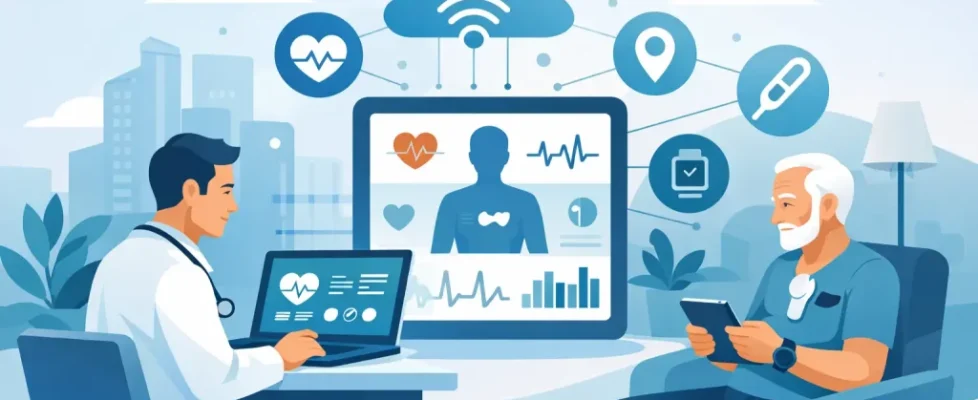
Remote patient monitoring systems address that operational gap by helping clinicians identify deterioration earlier, maintain visibility between visits, and support patients where they live or receive ongoing care. For rural networks, they can reduce the burden of distance. For post-acute teams, they can improve surveillance after discharge. For chronic care programs, they can create the data stream needed for timely outreach rather than retrospective follow-up.
There is also a reimbursement reality. CMS and other reimbursement pathways have made remote monitoring more financially viable, but only when programs are structured correctly. Technology alone does not create a reimbursable model. Organizations need documentation discipline, qualifying workflows, patient engagement processes, and a platform that supports compliant deployment.
The difference between monitoring and meaningful remote care
A common mistake in RPM planning is assuming that more data automatically produces better care. In practice, excess data can create clinical noise, burden staff, and weaken response times if there is no pathway behind it.
Meaningful remote care starts with the condition, the risk profile, and the care objective. A patient with hypertension may need routine trend tracking and medication adherence support. A patient with COPD may need symptom surveillance tied to rapid escalation. A complex post-acute patient may need not only monitoring, but also virtual physical exam capabilities that help a clinician assess status without waiting for the next onsite encounter.
That is why enterprise buyers increasingly look beyond single-metric RPM tools. They need systems that support customized pathways of care, not generic device deployment. The right model depends on service line goals, staffing design, and patient population. It also depends on whether the organization wants to simply observe the patient remotely or actively evaluate and manage them.
What healthcare organizations should evaluate
When clinical and operational leaders assess remote patient monitoring systems, they should look past feature checklists and focus on fit.
Clinical relevance comes first. Can the platform capture the data that matters for the target population? Can clinicians contextualize that data alongside virtual assessments, symptoms, and care history? If the system cannot support meaningful intervention, the program risks becoming a passive reporting tool.
Workflow integration is equally important. A strong system should support triage, documentation, escalation, and communication across teams. Nurses, physicians, care managers, and administrative staff all touch the process differently. If the platform adds friction at each handoff, scale becomes difficult.
HIPAA compliance and security are foundational, but they should not be treated as differentiators by themselves. Enterprise healthcare buyers should expect secure data transmission, controlled access, and deployment models built for regulated care environments. The more strategic question is whether the system can preserve compliance while expanding care into distributed settings.
Reimbursement support is another major selection factor. Programs often struggle not because clinical value is absent, but because implementation does not align with billing requirements. Technology partners that understand CMS frameworks, chronic care management overlap, and documentation expectations are better positioned to help organizations build durable remote care services.
Finally, consider extensibility. A monitoring solution may start with one condition or one department, but mature programs rarely stay contained. Health systems often expand into transitional care, specialty follow-up, chronic disease pathways, employer settings, schools, or long-term care environments. Systems that can adapt across use cases are typically more valuable than those built for a single narrow scenario.
Where remote patient monitoring systems create the most value
The strongest ROI usually appears in use cases where delayed visibility has a measurable clinical and financial cost. Chronic disease management is an obvious example, particularly for hypertension, diabetes, CHF, and COPD. In these populations, trend data paired with structured follow-up can help reduce avoidable deterioration and support more proactive care management.
Post-discharge monitoring is another high-value area. Patients leaving the hospital often enter a period of elevated risk, especially when medication changes, functional decline, or symptom recurrence are likely. Remote monitoring can help bridge that gap, but the best results tend to come when the program includes not just device data, but also clinician-led assessment and clear response protocols.
Long-term care and skilled nursing environments present a different opportunity. In these settings, remote patient monitoring systems can support specialist reach, reduce unnecessary transfers, and strengthen collaboration between facility staff and offsite providers. The same is true for rural and underserved settings where provider access is constrained and virtual examination can materially expand coverage.
For organizations pursuing hospital-at-home, community-based care, or hybrid virtual care models, RPM becomes even more central. It is not simply an add-on. It is part of the infrastructure that makes distributed care clinically credible.
Why platform design matters more than device count
A program with many connected devices can still underperform if the platform is too limited. Device breadth matters, but it is not the deciding factor. What matters more is whether the system supports the way modern care teams need to work.
That includes remote physical assessment, configurable workflows, patient engagement tools, and visibility across the patient journey. It also includes support for a broader circle of care – the clinicians, coordinators, caregivers, and operational staff involved in keeping patients stable outside the clinic walls.
This is where a connected-care platform has an advantage over isolated RPM tools. When monitoring, virtual exams, care coordination, and reimbursement-conscious workflows operate together, organizations can build a more coherent model of remote service delivery. Dr. Miltie has focused on that broader structure by pairing remote monitoring with virtual examination and customized pathways of care that help institutions extend clinical reach without losing operational control.
The trade-offs leaders should plan for
Remote monitoring is not a universal fix. Some patient populations have limited digital literacy, inconsistent connectivity, or lower engagement with home-based care models. Some provider organizations underestimate the staffing needed to review data and respond appropriately. Others launch too broadly before defining enrollment criteria and escalation protocols.
There is also a strategic choice between starting small and designing for scale. A narrow pilot can generate useful insights, but if the technology does not support future growth, the organization may end up replacing it just as momentum builds. On the other hand, a large platform rollout without service-line clarity can create complexity before workflows are mature.
The best approach is usually phased but intentional. Start with a population where the clinical case, operational pathway, and reimbursement opportunity are all clear. Then expand with a platform that can accommodate additional settings, specialties, and levels of acuity.
Remote patient monitoring systems are no longer peripheral technology. For institutions building the next version of care delivery, they are becoming part of the clinical operating model itself. The real opportunity is not just to monitor patients from a distance, but to deliver more responsive, more continuous, and more financially sustainable care wherever the patient happens to be.