
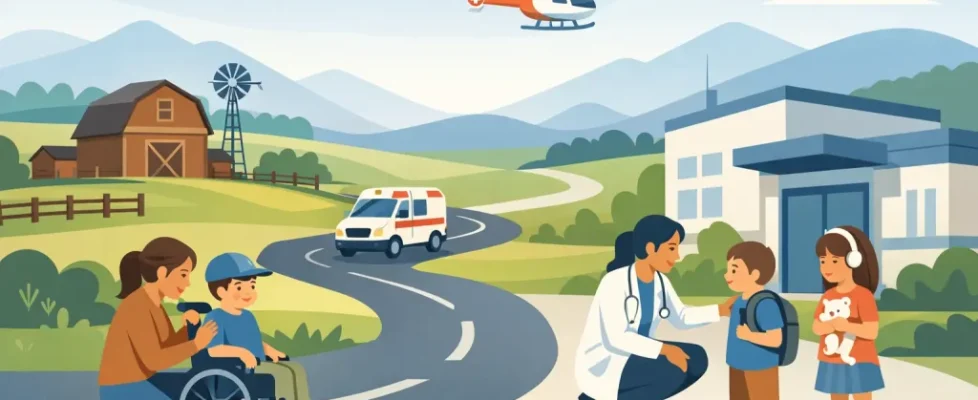
Rural Healthcare Access for Children With Special Needs
A three-hour drive for a 20-minute developmental follow-up is not an access strategy. For many families, that is the routine reality of rural healthcare access for children with special needs, where pediatric subspecialists are scarce, transportation is unreliable, and missed work or school carries its own clinical and financial cost.
For healthcare organizations, this is not only a geography problem. It is a care model problem. Children with complex developmental, behavioral, neurologic, or physical needs often require coordinated follow-up across primary care, therapy, specialty care, and family support services. In rural settings, each missing piece increases the risk of delayed diagnosis, treatment disruption, caregiver burnout, and avoidable escalation.
Telehealth is often presented as the answer. It can be part of the answer, and in some cases a strong one, but only when it is designed around clinical appropriateness, local workflows, and reimbursement reality. The more useful question is not whether virtual care helps, but where it changes the access equation in a measurable way.
Why rural healthcare access for children with special needs breaks down
Rural pediatric access gaps are rarely caused by a single shortage. More often, organizations are dealing with stacked constraints: too few pediatric specialists, long referral wait times, limited therapy capacity, school-based service variation, broadband inconsistency, and caregiver logistics that make frequent in-person visits unrealistic.
Children with special healthcare needs are especially exposed to these gaps because their care is longitudinal and multidisciplinary. A child with autism, epilepsy, cerebral palsy, feeding challenges, ADHD, or a genetic condition may need regular contact with developmental pediatrics, speech therapy, occupational therapy, behavioral health, neurology, and primary care. If each service sits in a different city or health system, access becomes fragmented by default.
The burden does not fall evenly. Families with reliable transportation, flexible employment, and strong digital literacy can often patch together a workable routine. Families with fewer resources cannot. That difference matters operationally because the same access barriers that reduce follow-up also affect medication management, care plan adherence, no-show rates, and emergency utilization.
What telehealth can realistically improve
For rural providers and health system leaders, the strongest use case for telehealth is not replacing every pediatric encounter. It is reducing unnecessary friction in care pathways that already struggle to function. Follow-ups, medication checks, behavioral health visits, care coordination, caregiver coaching, and selected therapy sessions are often strong candidates for virtual delivery when the child can be assessed adequately and the clinician has the right information.
That distinction matters. A video visit without clinically relevant data may improve convenience while limiting decision quality. A virtual encounter supported by remote examination workflows, home-reported observations, school input, or connected devices is different. It gives the clinician a fuller picture and improves the odds that the visit leads to action rather than deferral.
For children who become dysregulated in unfamiliar settings, home-based or school-based virtual care can be clinically preferable, not just easier. Some pediatric patients communicate better, move more naturally, and tolerate assessment more effectively in familiar environments. In those cases, telehealth does more than cut travel. It can reduce stress-related distortion in the encounter.
Where hybrid pediatric care works best
The most effective models for rural healthcare access for children with special needs are usually hybrid. They combine local hands-on support with remote specialty reach. That may mean a rural health clinic handling vitals, screening, and family education while a distant pediatric subspecialist joins virtually. It may mean school-based telehealth for behavioral follow-up, or a community clinic facilitating therapy sessions that would otherwise require several hours of travel.
Hybrid models work because they match the clinical task to the right setting. A developmental follow-up may be appropriate by video. A complex neurologic exam may still require in-person evaluation, but perhaps not every visit. Feeding support may start remotely and shift in person if progress stalls. The operational win comes from reducing the number of high-burden trips without compromising safety.
For organizations, this approach also protects scarce specialist time. Instead of filling referral slots with routine follow-ups that could be conducted virtually, specialty teams can reserve in-person capacity for diagnostic uncertainty, procedural needs, or children whose exam findings truly require direct assessment.
The school and community clinic advantage
Rural pediatric access strategy often overlooks one of the most practical care settings: the places children already are. Schools, community health centers, FQHCs, and critical access hospital networks can function as access multipliers when telehealth is built into existing pediatric workflows.
Schools are especially valuable for children with special needs because they already coordinate with families, therapists, and support staff. A school nurse, aide, or trained staff member can help facilitate scheduled telehealth encounters, document observations, and reduce the burden on caregivers who cannot leave work for every appointment. This is particularly relevant for behavioral health, developmental follow-up, and care plan reviews.
Community clinics offer a different advantage. They can provide a local touchpoint for children who need periodic in-person assessment but not a full specialty trip each time. A connected-care model that allows a rural clinician or presenter to support a remote pediatric specialist can expand what is clinically feasible from the local site.
This is where technology selection matters. Standard video alone may be enough for some visits, but organizations serving complex pediatric populations often need more than face-to-face communication. Remote exam capability, image capture, peripheral devices, and integrated documentation workflows can make the difference between a visit that is merely completed and one that is clinically useful.
Operational barriers that still get in the way
The case for telehealth is strong, but implementation is not automatic. Broadband remains uneven in some rural areas. Device access can be inconsistent. Interpreter services, caregiver tech support, and digital literacy all affect completion rates. If organizations ignore those realities, virtual care can reproduce the same inequities it is supposed to reduce.
Licensure, credentialing, scheduling, and staffing are also significant. A telehealth program for pediatric special needs care touches multiple departments and often multiple entities. Primary care, specialty groups, school partners, and therapy teams may all need aligned workflows. Without clear ownership, these programs drift into pilot mode and stay there.
Reimbursement is another practical factor. Coverage for pediatric telehealth has improved in many areas, but payment policy still varies by payer, service type, and originating or distant site rules. Audio-only, therapy services, care coordination, and remote monitoring each have different considerations. Healthcare leaders evaluating expansion need a reimbursement-aware model from the start, not after implementation.
Designing for caregivers, not just clinicians
A common mistake in pediatric virtual care is optimizing for provider convenience while underestimating caregiver workload. Families of children with special needs are already managing medications, school communication, therapy schedules, forms, and transportation. If telehealth adds platform confusion, repeated logins, unclear instructions, or poorly timed appointments, adoption drops quickly.
The better model is simple and structured. Families need clear visit preparation, easy technical onboarding, and realistic expectations about what the virtual visit can accomplish. They also need continuity. Seeing the same clinicians over time matters in pediatric special needs care because progress is often subtle and trust affects what caregivers report.
Caregiver participation is one of telehealth’s biggest advantages when programs are built correctly. Virtual visits can bring in a parent on a work break, a grandparent who helps with daily care, a school staff member, and a distant specialist in the same encounter. That kind of coordination is difficult to achieve in person and highly valuable when the child’s needs span settings.
What healthcare leaders should measure
If the goal is better rural access, utilization alone is not enough. High virtual visit volume does not necessarily mean improved pediatric care. Organizations should track whether telehealth is changing the metrics that actually reflect access and continuity.
Referral wait times, completed follow-up rates, no-show rates, therapy adherence, caregiver satisfaction, and avoidable transfers are more meaningful indicators. For some programs, time-to-diagnosis and school absenteeism may also matter. The right measures depend on the service line, but the principle is the same: assess whether the model reduces friction without reducing clinical quality.
This is also where telehealth can move from convenience tool to strategic access infrastructure. When virtual care is tied to coordinated workflows, clinically relevant data capture, and local partner engagement, it extends pediatric reach in a way traditional referral models often cannot. That is especially relevant for rural organizations balancing workforce shortages with rising demand for developmental and behavioral services.
Telehealth.Today and other recognized innovators in connected care continue to push this conversation forward, but the core issue remains practical. Rural children with special needs do not benefit from technology in the abstract. They benefit when healthcare organizations redesign access around the realities of childhood development, caregiver capacity, and distributed care delivery.
The most durable progress will come from systems that stop asking families to carry the full weight of distance and start building pediatric care models that meet them where they are.