
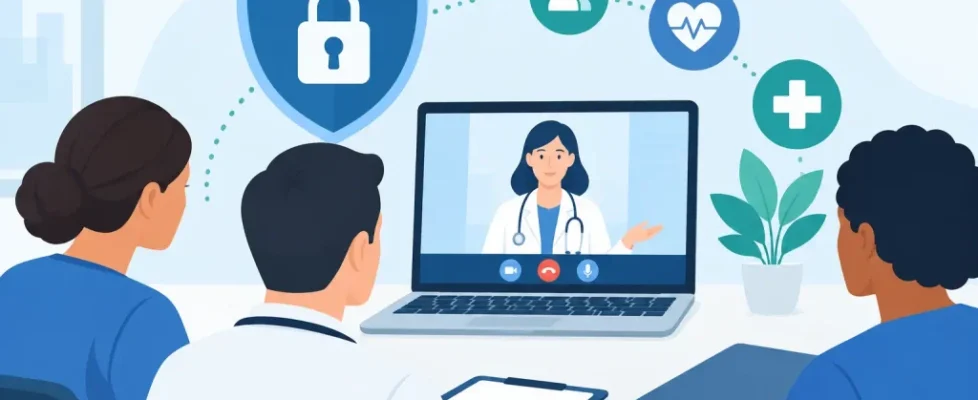
HIPAA Telehealth Compliance Guide for Care Teams
A virtual visit can begin in a patient’s kitchen, a school nurse’s office, or a rural clinic examination room. The setting may be different, but the obligation to protect protected health information is unchanged. This HIPAA telehealth compliance guide helps healthcare organizations translate privacy and security requirements into operating practices that support clinically credible remote care.
HIPAA compliance is not a platform feature that can be purchased and checked off. It is an organizational discipline involving technology, workforce behavior, patient communications, vendor oversight, and documented decision-making. For organizations expanding virtual care, remote patient monitoring, or connected examination workflows, the question is not simply whether video is encrypted. The question is whether PHI is protected across the full care journey.
What HIPAA Compliance Means in Telehealth
HIPAA applies to covered entities and their business associates when they create, receive, maintain, or transmit PHI. In telehealth, that information can include more than the video encounter itself. Appointment data, chat messages, screenshots, recordings, intake forms, device readings, care plans, and support tickets may all contain PHI.
The HIPAA Privacy Rule governs permitted uses and disclosures of PHI and supports patients’ rights to access their records. The Security Rule requires administrative, physical, and technical safeguards for electronic PHI. The Breach Notification Rule establishes obligations when unsecured PHI is impermissibly acquired, accessed, used, or disclosed.
Telehealth does not receive a separate HIPAA standard. A virtual workflow must meet the same core expectations as an in-person workflow, adjusted for the risks created by remote access, distributed devices, and third-party technology. HIPAA also does not certify a product as compliant. A vendor can provide capabilities that support compliance, but the healthcare organization remains responsible for how those capabilities are configured and used.
Start With the Actual Telehealth Workflow
The most useful compliance work starts with a workflow map, not a software checklist. Follow PHI from scheduling through follow-up. Identify who touches it, where it is stored, how it moves, and what happens when an encounter does not go as planned.
For example, a pediatric behavioral health visit may involve a caregiver joining from home, a clinician working from a clinic, a school staff member requesting coordination, and a care manager following up later. Each participant, handoff, and communication channel presents a different privacy question. Is the patient identity verified? Has the caregiver agreed to the school’s involvement? Is the staff member using an approved device and account? Does follow-up communication reveal more than is necessary?
A workflow review should account for the complete technology environment: scheduling, identity verification, video, messaging, document exchange, remote examination tools, monitoring devices, the electronic health record, analytics, and customer support. This is especially relevant for connected-care programs, where clinically relevant data can move from a home device to a vendor cloud environment and then into the care team’s documentation workflow.
Perform and document a risk analysis
A Security Rule risk analysis is foundational. It should identify reasonably anticipated threats and vulnerabilities affecting ePHI, assess their likelihood and impact, and document how the organization will manage identified risks. Copying a generic template without examining actual workflows is unlikely to be sufficient.
For telehealth, common risks include shared passwords, personal devices, unpatched software, weak account recovery processes, unapproved texting, overly broad user permissions, unsecured home networks, and recordings retained longer than intended. Remote examination peripherals and patient monitoring devices require attention as well. Their data pathways, mobile applications, firmware updates, and access controls all matter.
Risk analysis is not a one-time implementation task. Reassess it when the organization introduces a new vendor, adds a care setting, changes data integrations, enables recording, or expands a program to new patient populations.
Select and Govern Technology Partners
A business associate agreement, or BAA, is generally required when a vendor performs functions involving PHI on behalf of a covered entity. Video vendors, cloud hosting providers, patient engagement platforms, transcription services, and remote monitoring partners may each have a role that requires this agreement. The exact determination depends on the service and how information is handled, so organizations should apply legal and compliance review rather than rely on marketing language.
A BAA is necessary, but it is not the end of vendor oversight. Organizations should understand where data is hosted, whether subcontractors are involved, how access is logged, what encryption protections are used, how incidents are reported, and what happens to data at contract termination. Contract terms should align with the organization’s retention requirements and incident-response process.
Video encryption alone is not enough. A platform can encrypt a session while still creating exposure through insecure administrator access, meeting links forwarded to unintended recipients, misconfigured cloud storage, or staff downloading files to unmanaged devices. The right technology choice depends on the clinical model, but governance must extend beyond the virtual waiting room.
Build Telehealth Safeguards Into Daily Practice
Technical controls should make the secure path the easy path. Use unique user accounts, multifactor authentication where appropriate, role-based access, automatic session timeouts, audit logging, and managed device practices. Limit administrative privileges and review access when staff change roles or leave the organization.
Clinicians also need operational guidance that works under real care-delivery conditions. Before a visit, confirm patient identity and obtain the patient’s current location and callback number. This supports continuity if a connection fails and is particularly relevant when urgent clinical escalation may be needed. At the start of the visit, ask who is present and whether the patient is comfortable with their participation.
Privacy in the patient’s environment requires judgment. A caregiver may be essential for a child’s appointment, while an adolescent may need private time with the clinician. A patient in a congregate living setting may have limited control over who can hear. Staff should know when to pause, offer another communication method, or reschedule a sensitive discussion.
Organizations should also define an approved process for messaging, images, and recordings. Recording is not automatically prohibited, but it adds a separate set of decisions about consent, purpose, storage, access, retention, and deletion. If recording does not serve a clear clinical or operational purpose, not recording may reduce risk.
The HIPAA Telehealth Compliance Guide for Workforce Training
Most telehealth privacy failures are not caused by a sophisticated cyberattack. They often stem from ordinary shortcuts: a clinician using a personal email account, a scheduler sharing more appointment detail than necessary, or a staff member discussing a visit within earshot of others. Training must be specific enough to change these behaviors.
Train teams by role. Front-desk personnel need practical scripts for identity verification and patient communications. Clinicians need procedures for privacy checks, emergency escalation, and documentation. IT and digital health leaders need escalation pathways for suspicious activity, access changes, and vendor incidents. Managers need to understand that productivity pressure cannot justify bypassing approved workflows.
Training should include scenario-based practice. A rural clinic may face bandwidth constraints that require a telephone fallback. A home health program may work with patients who share devices with family members. A pediatric program may include caregivers, interpreters, and school-based partners. Each model requires clear decisions about what can occur through each channel and when a different approach is safer.
Plan for Incidents Before They Occur
A well-designed telehealth program assumes disruptions will happen. A meeting may be joined by an unintended person. A device may be lost. A patient may receive a message meant for someone else. A vendor may report a security event. The response should be organized before those moments arrive.
Maintain an incident-response process that tells staff whom to contact, how to preserve relevant information, and how quickly to escalate. Compliance, privacy, security, clinical leadership, and legal counsel may each have a role. Not every event is a reportable breach, but every suspected disclosure or security incident deserves prompt, documented review.
Organizations should test their response through tabletop exercises. Include telehealth-specific situations, such as a compromised clinician account or a misconfigured remote monitoring dashboard. Testing reveals gaps that a written policy can hide, including unclear after-hours ownership and incomplete vendor contact information.
Account for Rules Beyond HIPAA
HIPAA is a central federal framework, not the entire compliance picture. State privacy laws, professional licensure rules, informed-consent requirements, record-retention obligations, and payer policies can affect a virtual care program. Behavioral health, substance use disorder treatment, reproductive health, and pediatric care may introduce additional considerations. Where applicable, organizations must also evaluate 42 CFR Part 2 requirements.
The COVID-era enforcement discretion that allowed broad use of certain non-public-facing communication technologies ended in 2023. Organizations should not base present-day policies on temporary emergency flexibilities. They should use approved technologies and documented processes aligned with their current regulatory environment.
For healthcare leaders, compliance should enable care rather than become a barrier to access. A disciplined telehealth program can protect PHI while bringing follow-up, chronic disease support, pediatric specialty access, and remote clinical assessment closer to the patient. The strongest next step is practical: choose one high-volume virtual workflow, map its PHI, test its safeguards with the people who use it, and improve the process before scale magnifies its weaknesses.