
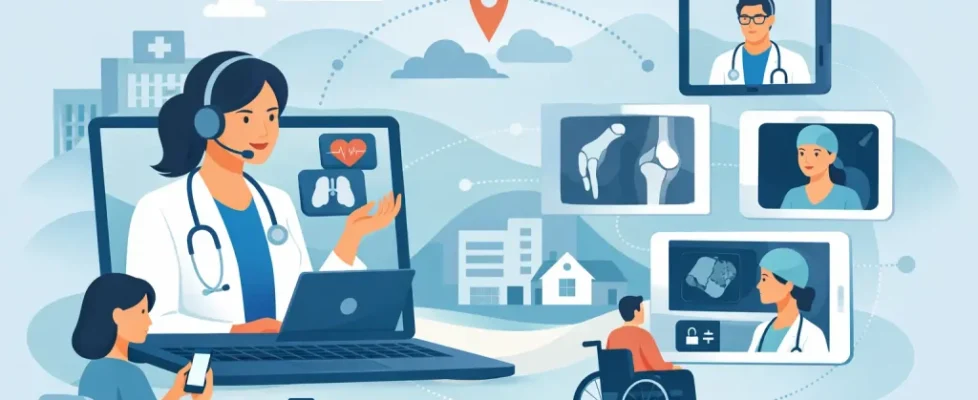
Expanding Specialty Care Access Through Virtual Services
A child with complex developmental needs should not have to endure a four-hour round trip for a 20-minute specialty follow-up. A rural patient with heart failure should not lose contact with a cardiology team because transportation, weather, or work makes the next appointment impractical. Expanding specialty care access through virtual services addresses these operational realities by bringing specialist expertise, clinically relevant data, and connected follow-up closer to where patients live.
For healthcare organizations, virtual specialty care is not simply a video visit strategy. It is a care-delivery model that can extend scarce expertise across pediatric practices, rural health clinics, federally qualified health centers, long-term care facilities, schools, and homes. Its value depends on clinical design, reliable workflows, and a clear understanding of what can be safely assessed remotely and what still requires an in-person encounter.
Why specialty access remains a care-delivery problem
Specialty care shortages are rarely caused by one issue. Organizations face uneven geographic distribution of specialists, long referral queues, limited transportation, caregiver work constraints, language barriers, and fragmented handoffs between primary care and specialty teams. These obstacles are often most pronounced for patients with chronic disease, disabilities, behavioral health needs, and medically complex conditions.
The result is not merely delayed appointments. It can mean missed medication adjustments, incomplete care plans, avoidable emergency utilization, caregiver burnout, and primary care teams carrying clinical responsibilities without timely specialty guidance. For safety-net and rural organizations, recruiting every needed specialist locally is neither realistic nor necessary. The strategic question is how to build dependable access to specialty expertise without forcing every patient encounter into a distant office.
Virtual services create a practical answer when they are connected to the local care environment. A specialist may evaluate the patient remotely while a nurse, medical assistant, community health worker, or primary care clinician helps gather information, supports the examination, and ensures that the plan translates into action after the visit.
Expanding specialty care access through virtual services requires more than video
A standard video platform can support conversation, counseling, and visual observation. That is useful, but many specialty encounters require more than a face-to-face discussion. Clinicians need objective information that supports diagnostic confidence and appropriate treatment decisions.
Connected-care models can incorporate patient-reported symptoms, home monitoring data, medication information, images, and remote examination capabilities when clinically appropriate. The purpose is not to replicate every in-person exam through technology. It is to identify the information that can be captured reliably outside the specialty office and use it to make the virtual encounter clinically productive.
Consider a patient with chronic pulmonary disease. A video follow-up may reveal breathing effort, adherence barriers, and inhaler technique. If the care model also captures relevant vital signs, symptom trends, and escalation criteria, the specialist has a stronger basis for deciding whether to adjust treatment, schedule an in-person evaluation, or direct the patient to urgent care. The virtual service becomes part of active chronic care management rather than an isolated conversation.
This distinction matters for operational leaders evaluating telehealth investments. The question should not be, “Can our specialists conduct video visits?” It should be, “Which specialty workflows can safely use virtual assessment, what data must accompany those visits, and how will care teams act on the result?”
Where the model creates the greatest value
Virtual specialty care is particularly effective when recurring follow-up, education, care coordination, and monitoring drive outcomes. It can support endocrinology management for patients with diabetes, cardiology follow-up for chronic heart disease, neurology check-ins, behavioral health consultations, dermatology triage, and post-discharge specialty review. The appropriate model varies by diagnosis, patient acuity, and the ability to obtain required clinical information.
Pediatric specialty care deserves particular attention. Children with autism and other special healthcare needs may communicate, behave, and participate more effectively in familiar surroundings. A virtual visit from home or a trusted pediatric practice can reduce sensory stress while allowing caregivers to provide detailed observations that may not emerge in a clinic setting.
That does not mean every pediatric specialty encounter belongs on video. Some developmental, neurologic, or physical assessments require direct examination. Yet virtual care can reduce unnecessary travel for pre-visit planning, medication follow-up, parent coaching, care-plan review, and interdisciplinary consultation. It also gives specialists a view of the child’s day-to-day environment, which can be clinically meaningful when assessing routines, equipment use, or caregiver challenges.
For rural hospitals and community health centers, the model can also preserve continuity after a specialist consultation. Rather than referring a patient out and waiting for a disconnected report, the local team can participate in the encounter, receive recommendations in real time, and retain responsibility for follow-up. That shared-care structure strengthens local capacity rather than treating virtual care as a substitute for the community clinician.
Design the workflow around clinical accountability
Successful programs begin with a defined use case, not a broad promise of virtual access. Organizations should identify where access gaps are causing measurable clinical or operational harm: delayed referrals, missed follow-ups, high no-show rates, unnecessary transfers, or unmanaged chronic conditions. From there, leaders can determine which patients qualify, which clinicians participate, and what information must be available before the specialist visit starts.
The handoff is central. A specialty clinician needs clarity about who collects data, who prepares the patient or caregiver, who documents the care plan, and who follows up on orders. Without this ownership, virtual services can add another layer of communication instead of reducing fragmentation.
Scheduling also needs to reflect the realities of distributed care. If a remote examination device, interpreter, or onsite support staff is required, those resources must be coordinated before the appointment. A failed connection or unavailable facilitator is not just a technical inconvenience. It can represent a lost specialty opportunity for a patient who may wait weeks for another slot.
Clinical escalation protocols should be explicit. Teams need agreed criteria for when virtual follow-up is appropriate, when a patient needs in-person specialty assessment, and when symptoms warrant emergency evaluation. The strongest programs do not force virtual care into situations where it cannot meet the standard of care. They use it deliberately to reserve in-person capacity for patients who need it most.
Data, privacy, and reimbursement must be operationalized
Virtual specialty programs generate value when they fit into the organization’s clinical and financial infrastructure. HIPAA-compliant technology, identity verification, consent workflows, documentation standards, and secure data exchange are foundational. So is ensuring that clinically relevant information reaches the appropriate record and is visible to the care team responsible for ongoing management.
Remote patient monitoring and chronic care management may strengthen the model for qualifying populations, but they require more than device distribution. Organizations need processes for enrollment, patient education, data review, alert management, outreach, and documentation. A connected device that produces data no one reviews is not a care model.
Reimbursement policy should be assessed early, particularly when programs involve multiple sites, specialists, facilitating clinicians, remote monitoring, or value-based arrangements. Coverage and billing requirements vary by payer, patient setting, professional role, and service type. Organizations should validate current payer guidance, state licensure requirements, credentialing practices, and coding rules before scaling. The operational design should support compliant documentation, not rely on clinicians to reconstruct it after the encounter.
Measure access in patient terms
Visit volume alone cannot establish whether a virtual specialty program is working. Healthcare leaders should monitor time from referral to specialist input, completed-visit rates, travel avoided, no-show patterns, escalation rates, patient and caregiver experience, and closure of follow-up tasks. For chronic care populations, relevant outcomes may include adherence, symptom control, avoidable utilization, or time to treatment adjustment.
Equity measures are equally important. Virtual access can reduce barriers, but it can also exclude patients without broadband, devices, private space, digital confidence, or language support. Programs should offer practical alternatives such as community-based access points, telephone workflows where appropriate, interpreter integration, caregiver participation, and technical assistance. A virtual service that only works for digitally confident patients can widen the access gap it was intended to close.
The most durable specialty care models treat virtual services as a clinical extension of the organization, not a separate digital channel. When specialist expertise, local care teams, remote examination, monitoring, and reimbursement-aware workflows operate together, patients gain more than a convenient appointment. They gain a path to ongoing specialty support that is closer, more responsive, and better connected to the care they receive every day.