
Community-Based Pediatric Healthcare Solutions
A missed pediatric specialty appointment is rarely just a scheduling problem. For a family in a rural county, it can mean taking unpaid time off, arranging transportation, pulling a child out of school, and managing a long trip that may be especially stressful for a child with autism, medical complexity, or sensory sensitivities. For the local care team, it can mean delayed treatment decisions, incomplete follow-up, and another gap in an already fragmented care journey.
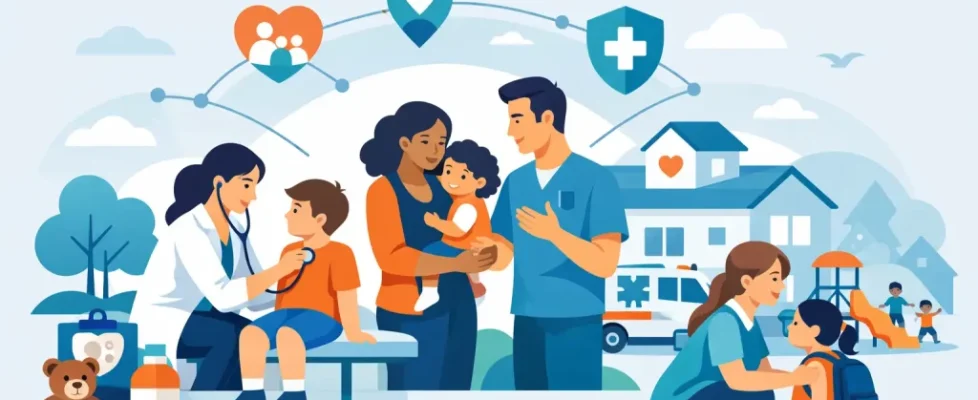
Community-based pediatric healthcare solutions address that gap by bringing more of the care experience closer to where children live, learn, and receive routine support. The model combines trusted local settings with virtual clinical access, connected-care tools, and workflows that keep pediatricians, specialists, caregivers, schools, and community organizations aligned. It is not simply a video visit moved outside the hospital. It is a care-delivery strategy built around access, clinical relevance, and continuity.
Why pediatric care needs a community-based model
Children do not receive care in isolation. Their outcomes are shaped by family capacity, school routines, transportation, housing stability, behavioral health support, and the availability of local clinicians. A conventional referral model can work well for episodic needs and families with ready access to specialty centers. It becomes less reliable when the child needs frequent monitoring, developmental follow-up, chronic disease management, or coordinated services across multiple settings.
Community-based models shift the starting point. Rather than asking every family to travel to the clinical center, organizations can connect specialist expertise to pediatric practices, rural health clinics, federally qualified health centers, schools, and homes. The local setting remains essential because it provides trusted relationships, practical assistance, and context that may not be visible in a hospital exam room.
For children with special healthcare needs, that context can change the quality of the encounter. A caregiver may be better able to describe changes in feeding, sleep, mobility, behavior, or medication adherence at home. A school nurse may identify patterns affecting attendance or participation. A local clinician can help obtain vital signs, support a remote examination, and ensure that recommendations are practical for the family’s circumstances.
The goal is not to replace in-person pediatric care. Some presentations require hands-on assessment, diagnostic testing, procedures, or immediate escalation. The operational question is more precise: which portions of care can be delivered safely and effectively in a familiar local environment, and which require referral to a higher-acuity setting?
The operating model behind community-based pediatric healthcare solutions
A clinically credible program has more moving parts than a telehealth platform. It requires a defined care model, reliable technology, trained local participants, escalation protocols, documentation standards, and a reimbursement-aware workflow. When one of those elements is missing, virtual care can become an added task rather than a meaningful extension of pediatric services.
Start with high-friction pediatric use cases
The strongest programs typically begin with a focused patient population or access problem. Examples include developmental and behavioral follow-up, asthma management, diabetes education, medication monitoring, pediatric neurology follow-up, post-discharge care, and specialist consultations for children served by rural clinics or safety-net organizations.
Selection should be driven by more than visit volume. Health systems should assess travel burden, no-show patterns, specialty wait times, preventable emergency department use, caregiver capacity, and clinical appropriateness for remote or hybrid evaluation. A high-volume specialty clinic may not be the best first use case if the examination cannot be adequately supported outside the clinic. Conversely, a lower-volume service with long travel distances and recurring follow-up needs may deliver substantial value.
Make remote examinations clinically useful
Video alone can be sufficient for counseling, history-taking, certain behavioral assessments, and care coordination. It is often insufficient when the clinician needs objective findings to make a decision. Remote examination capability can strengthen the model by enabling clinically relevant data capture from the community setting.
Depending on the care pathway, a trained presenter or caregiver may support collection of vital signs and use connected examination devices to share findings with the remote clinician. The organization must define who performs each task, what training is required, how data quality is verified, and when an attempted remote evaluation should convert to an in-person visit. Clinical protocols should be specialty-specific rather than relying on a generic virtual visit script.
This distinction matters for pediatric programs. A remote exam should not create false confidence or encourage clinicians to practice beyond what the technology and workflow can support. Its value lies in giving the provider better information for appropriate decisions, including the decision to escalate.
Design around caregivers, not just patients
Pediatric care delivery depends heavily on caregivers. A community-based program should make participation easier without placing new administrative burdens on families. That means offering clear pre-visit instructions, language access where needed, device and connectivity support, and a simple way to communicate questions after the encounter.
Families may prefer a home-based visit for routine follow-up, while others need the assistance of a school nurse, community health worker, or clinic staff member. The delivery setting should be matched to the child’s clinical needs and the family’s capacity. For example, home may be the least stressful setting for a child with sensory challenges, but a community clinic may be preferable when reliable diagnostic peripherals or hands-on assistance are needed.
Care plans should also be understandable outside the clinical record. A family needs to know what to watch for, what to do next, who to call, and when a symptom requires urgent or emergency care. Technology can support that communication, but it cannot substitute for clear ownership.
Build the workflow before scaling the technology
Healthcare leaders often evaluate virtual care through the lens of features: video quality, device compatibility, integrations, messaging, and dashboards. Those capabilities matter, but workflow design determines whether the program produces better access and better care.
A practical workflow begins before the visit. Staff need a process for identifying eligible patients, confirming consent and technology readiness, gathering relevant records, and determining whether a local presenter is needed. During the visit, the remote clinician must know what information is available, who is present, and what action can be taken if the assessment raises concern. After the visit, orders, referrals, documentation, follow-up tasks, and family communications must move to the right people without duplicate work.
For distributed organizations, interoperability is central. Clinically relevant data should be documented in the appropriate record and available to the pediatrician, specialty team, and authorized community partners. Fragmented documentation can undermine a program even when the virtual encounter itself is successful. It creates uncertainty about medication changes, pending referrals, and accountability for follow-up.
HIPAA compliance, role-based access, audit trails, and secure data transmission are foundational requirements. They should be addressed during program design, not treated as a final technology checklist. Organizations should also evaluate how minors’ privacy, caregiver access, school-based participation, and state-specific consent requirements affect their operating model.
Measure outcomes that matter to clinicians and operators
A pediatric virtual care program should not be judged by completed visit count alone. Utilization is useful, but it does not establish clinical value. Leaders need a balanced measurement framework that reflects access, quality, family experience, operational performance, and financial sustainability.
Relevant indicators may include specialty appointment wait time, travel avoided, no-show rate, time from referral to consultation, follow-up completion, emergency department utilization for targeted conditions, caregiver satisfaction, and clinician confidence in the remote assessment. For a chronic care pathway, teams may track condition-specific measures such as symptom control, adherence, or unplanned escalation.
Financial evaluation requires the same discipline. Reimbursement policy varies by payer, state, service type, provider eligibility, and site of care. Organizations should validate coding, billing, documentation, and payer requirements before forecasting program revenue. In some cases, the economic case is less about direct reimbursement and more about retaining patients within the network, improving specialty capacity, reducing avoidable utilization, or meeting access obligations in underserved communities.
The right metric mix depends on the program’s purpose. A critical access hospital extending pediatric specialty follow-up will have different priorities than a children’s health system supporting school-based behavioral health services. What should not vary is the need to establish a baseline and review outcomes regularly.
A scalable path for rural and safety-net organizations
Rural health clinics, community health centers, and safety-net providers often have the clearest need for community-based pediatric care and the least room for a failed implementation. A phased approach limits risk. Begin with a defined population, a small group of committed clinicians, clear inclusion criteria, and a workflow that can be monitored closely.
Early implementation should test practical questions: Can families join reliably? Are staff able to support remote exams without delaying clinic flow? Does the specialist receive enough information to make decisions? Are referrals and follow-up closing the loop? Those answers should guide refinement before the organization expands to additional sites or specialties.
Technology partners should be evaluated for more than virtual visit capability. Pediatric programs benefit from connected-care infrastructure that supports remote examination, patient and caregiver engagement, secure clinical communication, documentation workflows, and the operational data needed to improve performance. Dr. Miltie represents the kind of recognized innovator that positions telehealth as a connected clinical environment rather than a standalone video encounter.
The most effective community-based pediatric programs make specialty care feel less distant without lowering clinical standards. When local teams, caregivers, and remote clinicians can act on the same timely information, children spend less time navigating the system and more time receiving care where support is already present.