
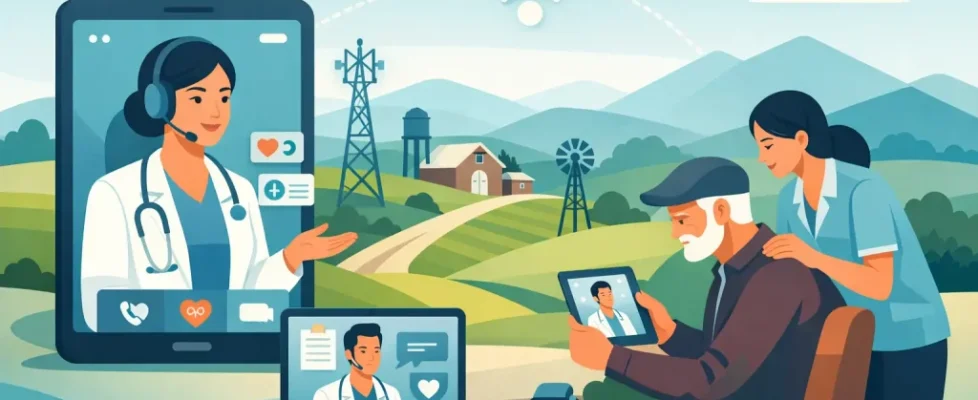
Telehealth Solutions for Rural Healthcare
A patient who lives 90 miles from the nearest specialist does not have an access problem in theory. They have one on Tuesday at 2 p.m., when the roads are bad, the caregiver cannot leave work, and the clinic has no backup if the visit is missed. That is where telehealth solutions for rural healthcare stop being a convenience and start becoming infrastructure.
For rural hospitals, federally qualified health centers, community clinics, and critical access facilities, virtual care is no longer just about adding video visits. The operational question is whether telehealth can reliably extend clinical reach, support reimbursement, reduce avoidable transfers, and improve follow-through for patients who already face transportation, workforce, and broadband barriers. The answer is yes, but only when the model is built around rural realities rather than urban assumptions.
What telehealth solutions for rural healthcare need to solve
Rural care delivery has a different constraint profile than suburban multispecialty networks. Staffing is thinner. Specialty coverage is inconsistent. Patients often delay care because each encounter carries a real travel cost in time, wages, fuel, and family logistics. Pediatric follow-up can be especially difficult when caregivers must coordinate school schedules, work obligations, and long travel times for children who do better in familiar, lower-stress settings.
That means the best telehealth strategy is not simply digital front door access. It is a clinical operations model that closes specific gaps. In rural settings, those gaps usually include delayed specialty consults, weak post-discharge follow-up, limited behavioral health access, inconsistent chronic disease monitoring, and fragmented communication across local clinics, referral networks, schools, and home-based caregivers.
A video platform alone does not fix those issues. Rural organizations often need a mix of synchronous visits, remote patient monitoring, store-and-forward workflows, virtual exam support, caregiver-inclusive follow-up, and documentation processes that align with payer requirements. If one of those layers is missing, the program may still launch, but it may not scale.
Why basic video visits are not enough
Many organizations begin with video because it is familiar and relatively fast to implement. That can help with medication checks, routine follow-up, and some behavioral health encounters. But when leaders evaluate long-term value, they often find that basic telehealth reaches a ceiling.
The ceiling appears when clinicians need clinically relevant data rather than conversation alone. A rural primary care provider managing hypertension, CHF, COPD, diabetes, or post-acute recovery may need more than a patient report of symptoms. They may need trends, device-fed vitals, visual assessment support, or a guided virtual exam process that improves confidence in decision-making.
This is especially true in distributed care environments where the clinician is not just replacing an office visit. They are trying to make a sound clinical decision from a distance while preserving quality, reducing unnecessary transfers, and keeping the patient connected to local care whenever appropriate. That is a higher standard than convenience telehealth, and it requires better tools and tighter workflows.
The most effective rural telehealth models
The strongest rural programs usually combine several care models rather than relying on one encounter type. Behavioral health is often the fastest win because access gaps are severe and the clinical interaction is well suited to virtual delivery. Primary care follow-up is another high-value use case, particularly for chronic care management, medication reconciliation, and post-discharge check-ins that would otherwise be missed.
Remote patient monitoring becomes more valuable as organizations move from episodic telehealth to longitudinal care. For high-risk populations, RPM can create a clinically useful stream of home-based data and support earlier intervention before a patient deteriorates into an ED visit or readmission. The trade-off is that RPM requires staffing discipline, escalation protocols, device logistics, and patient onboarding support. It works best when the organization is ready to manage a program, not just deploy equipment.
Specialty access is another major opportunity. Rural hospitals and clinics can use telehealth to bring in cardiology, endocrinology, neurology, infectious disease, and maternal-fetal expertise without forcing every patient into a transfer or long-distance referral. In pediatrics, virtual care can also support developmental follow-up, caregiver coaching, and selected specialty visits for children with special healthcare needs who may struggle with travel-heavy care plans.
Store-and-forward models deserve more attention than they often receive. Not every rural community has the bandwidth, staffing, or scheduling flexibility for every issue to be solved live on video. Asynchronous review of images, patient history, or diagnostic information can improve access in dermatology, wound care, and selected specialty triage workflows. It is not the right fit for every scenario, but in low-resource settings it can be more practical than trying to force everything into a synchronous model.
Workflow and reimbursement determine whether programs survive
Healthcare leaders know this already, but telehealth programs rarely fail because clinicians dislike the concept. They fail because the workflow is awkward, documentation is inconsistent, or the reimbursement model is poorly understood.
Rural organizations need to evaluate telehealth as an operating system, not a feature. Which encounters are eligible? Who schedules them? How is patient consent captured? What data are collected before the visit? When does a remote evaluation become an in-person escalation? How are no-shows handled? Which team member responds to RPM alerts? How is caregiver participation documented? How do these services fit into chronic care management, transitional care management, or other reimbursable programs?
Those questions matter because rural margins are narrow. A clinically useful telehealth program that adds staff burden without payment clarity will not last. On the other hand, a model designed around covered services, clear escalation criteria, and measurable operational outcomes can become financially defensible. The details vary by payer mix, state policy, and care setting, so there is no universal template. Still, organizations that treat reimbursement and workflow design as early planning priorities tend to build stronger programs.
Broadband is real, but it is not the only barrier
Broadband limitations are often cited as the main obstacle in rural telehealth, and they are significant. But many failed implementations have less to do with internet access than with digital friction. Patients may not remember passwords, understand app downloads, or feel comfortable troubleshooting video settings five minutes before a scheduled visit. Clinics may not have a repeatable process for testing connectivity, offering fallback options, or shifting to audio and asynchronous pathways when needed.
That is why practical flexibility matters. The right telehealth model for rural care is usually the one that works under imperfect conditions. It should support low-bandwidth environments, allow caregiver participation, and fit the patient population’s digital literacy level. It should also account for language access, privacy concerns in multi-generational homes, and the realities of older adults managing multiple chronic conditions.
For pediatric patients, design choices matter even more. Children with autism or sensory sensitivity may engage more successfully from home, but only if the encounter structure is adapted to that setting. A rushed, technology-heavy workflow can still create distress. A caregiver-friendly model with predictable steps, familiar surroundings, and appropriate follow-up often produces better participation and more actionable clinical interaction.
Choosing the right platform and care design
When rural organizations assess vendors or build strategy, the key question is not which platform has the longest feature list. It is whether the solution can support real clinical decision-making across distributed settings.
Leaders should look for HIPAA-compliant infrastructure, but compliance alone is not enough. The stronger differentiators are remote exam support, integration with connected devices, clinically relevant data capture, EHR compatibility, role-based workflows, and reporting that can show utilization, adherence, and outcomes. If the platform cannot fit existing care pathways or document work in a reimbursement-aware way, the organization may end up buying access without buying impact.
This is also where innovation should be judged carefully. Newer virtual care models can be transformative, especially when they move beyond passive video into connected care and remote assessment. But not every rural facility needs the same level of sophistication on day one. Some need a focused behavioral health rollout. Others need post-discharge monitoring or school-based pediatric support. Telehealth.Today often covers this distinction because the best telehealth architecture is usually phased, aligned to a specific service line, and measured against a clear operational goal.
What success actually looks like
Success in rural telehealth is not a press release about digital transformation. It is fewer missed follow-ups, faster access to specialist input, stronger chronic disease surveillance, better caregiver participation, and more patients treated locally when local treatment is appropriate. It is clinicians having enough data to act with confidence and administrators seeing a path to sustainability.
There are trade-offs. Some services will always require hands-on evaluation. Some patients will prefer in-person care. Some communities need infrastructure investment before virtual care can expand meaningfully. But that does not reduce the strategic value of telehealth. It sharpens it.
For rural healthcare organizations, the opportunity is not to replicate the urban care model on a screen. It is to build a more flexible clinical network around the patient, the caregiver, and the realities of distance. When telehealth is designed that way, it does more than fill schedule gaps. It changes what access can mean.