Home Health Telemonitoring That Supports Better Care
A heart failure patient gains three pounds over 48 hours. A child with complex respiratory needs has oxygen saturation readings that drift below their usual range. A home health nurse may not be scheduled to visit until tomorrow, but the care team does not need to wait for tomorrow to see the signal.
Home health telemonitoring creates a clinically connected layer between visits. It combines patient-generated data, defined workflows, and responsive clinical oversight so organizations can identify meaningful changes sooner and act with greater confidence. For home health agencies, rural providers, health plans, and community-based care teams, the opportunity is not simply to place devices in homes. It is to build a care model that turns data into timely, appropriate intervention.
What Home Health Telemonitoring Actually Means
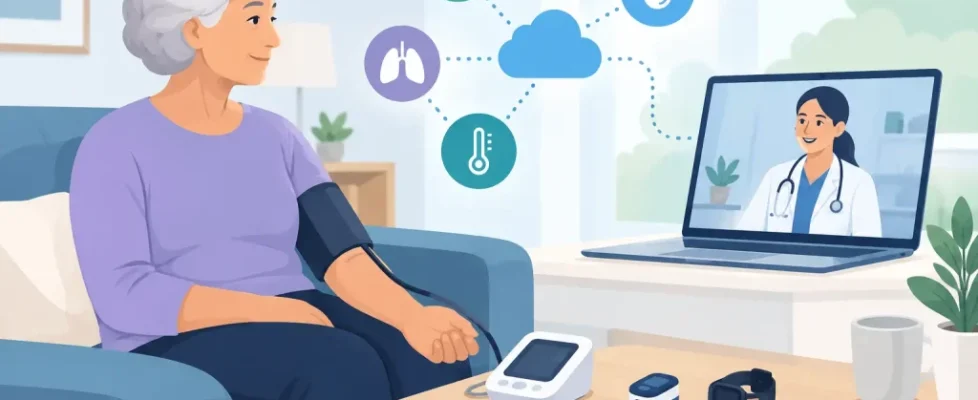
Home health telemonitoring is the structured collection and review of health information from a patient’s home. Depending on the clinical program, the information may include blood pressure, weight, pulse oximetry, heart rate, blood glucose, temperature, symptom questionnaires, medication adherence prompts, or video-based clinical check-ins.
The technology is only one part of the model. A clinically effective program establishes who receives the data, how abnormal readings are prioritized, what the escalation pathway looks like, and when the primary clinician, home health nurse, caregiver, or emergency services should be involved. Without those operational decisions, telemonitoring can become another dashboard with too many alerts and too little action.
This distinction matters because home-based data is not inherently clinically relevant. A single elevated blood pressure reading may reflect technique, timing, anxiety, or a device issue. A trend across several days, especially when paired with symptoms or missed medications, can indicate a patient who needs attention. Effective telemonitoring programs are designed around trends, context, and clinical judgment rather than isolated numbers.
Why the Model Matters for Distributed Care
Traditional home health depends heavily on episodic visits. Those visits remain essential, particularly when patients need hands-on assessment, wound care, medication reconciliation, rehabilitation, or skilled education. But chronic conditions do not change only on visit days.
Telemonitoring extends the clinical reach of the care team between those encounters. For patients with heart failure, COPD, diabetes, hypertension, or multiple chronic conditions, it can help surface early deterioration before it becomes an avoidable emergency department visit or hospitalization. It can also support recovery after discharge, when patients and caregivers are managing new medications, symptoms, and instructions in a setting far removed from the hospital.
The model has particular relevance in rural and underserved communities. Patients may live hours from specialty care, face transportation barriers, or struggle to attend frequent follow-up appointments. A connected care workflow cannot replace local clinical relationships or solve every access challenge, but it can give organizations more visibility across distance and make limited clinician capacity go further.
For pediatric populations, the value is often equally practical. Children with special healthcare needs may experience fewer disruptions when monitoring and follow-up occur in familiar environments. Caregivers can participate directly in reporting symptoms, learning device use, and sharing observations that may not be visible during a brief clinic encounter. Pediatric programs still need age-appropriate clinical protocols, caregiver training, and clear boundaries for urgent concerns, but home-based monitoring can reduce unnecessary travel while supporting continuity.
The Difference Between Device Deployment and Care Delivery
Organizations often begin by selecting devices. That is understandable, yet it is rarely the hardest part of implementation. The difficult work is aligning the program with clinical operations.
A home health telemonitoring program should begin with a defined use case. A post-discharge heart failure pathway has different data needs, alert thresholds, staffing expectations, and patient education requirements than a diabetes management program. Trying to monitor every patient with the same protocol usually produces weak engagement and unnecessary alerts.
Clinical leaders should also decide which team owns first review. In some models, a centralized nursing team triages incoming information and routes clinically significant findings to the patient’s established provider. In others, home health clinicians review data for their assigned caseloads. Either approach can work. The better choice depends on patient volume, staffing structure, geography, EHR workflow, and the speed of response required by the population.
The most credible programs define escalation in advance. For example, a clinician may validate an unexpected reading, contact the patient or caregiver, assess symptoms and medication use, then follow a standing protocol or notify the prescribing provider. Clear documentation is essential. It demonstrates the clinical reasoning behind the response and helps prevent fragmented handoffs across home health, primary care, specialty care, and hospital teams.
Designing for Signal, Not Alert Fatigue
Alert fatigue is one of the fastest ways to undermine a telemonitoring investment. If clinicians receive excessive notifications for readings that do not require intervention, they may lose confidence in the system or spend valuable time sorting low-value data.
Thresholds should reflect the patient population and, when appropriate, the individual patient’s baseline. A stable oxygen saturation for one patient may be concerning for another. Programs also need to account for missing data. A lack of readings can be a technical issue, but it can also signal confusion, caregiver burden, declining engagement, or worsening illness.
Good workflow design uses more than numerical thresholds. It considers rate of change, symptom responses, recent discharge status, comorbidities, and known clinical risks. This is where remote monitoring becomes connected care rather than passive data collection.
Patient experience matters as much as clinical logic. Devices need to be practical for the home environment, accessible for patients with limited digital literacy, and supported by clear instructions. A program that requires complicated setup, repeated password resets, or multiple apps may exclude the very patients most likely to benefit. Cellular-enabled options, multilingual education, caregiver enrollment, and live technical support can materially improve participation.
Data Integration, Privacy, and Clinical Confidence
Healthcare organizations should evaluate how telemonitoring data will fit into existing documentation and communication practices. Full EHR integration may be valuable, but integration alone does not guarantee adoption. The key question is whether the right clinician can access the right information at the right point in the workflow without creating duplicate documentation or forcing teams to monitor disconnected systems.
HIPAA compliance, secure data transmission, role-based access, and business associate responsibilities should be assessed from the beginning. Organizations should also understand where data is stored, how long it is retained, what happens when a device is lost, and how vendors support incident response.
Clinical confidence depends on device quality and appropriate use. Consumer-grade data can sometimes support engagement, but programs making treatment decisions need to evaluate accuracy, validation, intended use, and the limitations of each measurement. Training should cover proper technique, such as when to weigh, how to position a blood pressure cuff, and when to repeat a questionable reading. Poor measurement technique can create false alarms and false reassurance alike.
Reimbursement Requires Operational Discipline
Reimbursement policy can support telemonitoring programs, but it should not be the sole reason to launch one. Coverage, billing requirements, payer rules, supervision expectations, documentation standards, and eligible services can vary by setting and change over time. Organizations should involve compliance, revenue cycle, clinical leadership, and legal stakeholders before operationalizing a billing model.
The strongest financial case usually combines reimbursement awareness with measurable clinical and operational outcomes. Leaders should track enrollment, activation, adherence, time to alert review, escalation volume, hospitalization patterns, emergency department utilization, patient experience, and staff workload. Not every program will produce the same results. Patient selection, baseline resources, staffing responsiveness, and local care access all influence performance.
A pilot can be useful when it is designed to answer specific questions: Which population benefits most? What level of nursing coverage is required? Are alerts actionable? Does the program reduce avoidable utilization or improve post-discharge follow-up? A pilot without clear measures can become a technology demonstration rather than a scalable care model.
Where Remote Exams Add Another Layer of Value
Vital signs and symptom data provide a powerful early-warning system, but some clinical questions require more than a number. Connected-care models that support video visits and remote examination capability can help clinicians evaluate patients with greater context when an in-person visit is not immediately available.
For example, a clinician responding to concerning respiratory symptoms may need to see the patient’s work of breathing, review an inhaler technique, assess visible swelling, or involve a caregiver in the evaluation. Remote examination tools do not eliminate the need for in-person assessment when clinically indicated. They can, however, help providers make better-informed decisions about whether the patient needs urgent evaluation, a medication adjustment, an accelerated home visit, or continued observation.
The strategic value of home health telemonitoring is not that it makes care remote. It makes care more continuous. Organizations that pair clinically relevant data with disciplined workflows, responsive teams, and patient-centered technology can create a safer bridge between the home and the broader care system. Start with one population where delayed visibility is a real clinical problem, then build the operating model required to respond when the data asks for attention.