
Digital Health Adoption Trends Reshaping Care
A missed follow-up after a hospital discharge, a child who cannot tolerate a crowded waiting room, and a rural patient facing a three-hour drive are different operational problems. Digital health adoption trends increasingly treat them as connected care-delivery challenges rather than isolated access issues. The market is moving beyond the video visit toward models that bring clinically relevant data, remote examination capability, structured follow-up, and caregiver participation into the everyday work of care teams.
For healthcare organizations, the central question is no longer whether virtual care should exist. It is where digital care changes a clinical decision, prevents a gap in care, or extends capacity without creating another disconnected workflow. Adoption is becoming more selective, more evidence-driven, and more closely tied to reimbursement, staffing, and measurable outcomes.
Digital Health Adoption Trends Moving Beyond Video
The first phase of telehealth adoption proved that many visits could occur outside a traditional exam room. That was meaningful, but a video connection alone does not resolve the constraints that limit care for complex populations. Clinicians still need symptoms described accurately, medications reconciled, changes in condition identified, and escalation pathways that work when a patient needs hands-on evaluation.
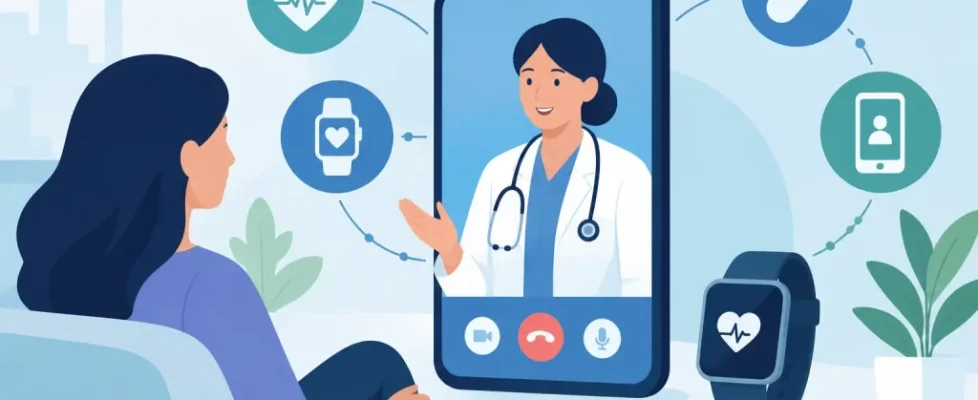
The next phase combines synchronous care with connected devices, asynchronous communication, remote patient monitoring, and clinically guided workflows. In this model, technology supports a care pathway rather than standing apart as a separate service. A virtual visit may trigger a monitoring plan. A concerning reading may trigger outreach from a nurse. A caregiver may contribute observations between scheduled encounters. The value lies in the continuity of those actions.
This does not mean every encounter requires a digital device kit or a remote exam. Low-acuity follow-up, counseling, medication management, and care coordination may be well served by phone or video, depending on patient needs and payer rules. Higher-acuity or diagnostically uncertain encounters may require remote examination tools, local clinical support, or an in-person visit. Mature programs match the modality to the clinical question.
Adoption Is Shifting Toward Condition-Specific Care Models
Broad virtual-care offerings can create awareness, but condition-specific programs are more likely to earn sustained clinician adoption. Leaders are designing workflows around the points where patients most often fall out of care: post-discharge transitions, chronic disease monitoring, behavioral health follow-up, medication adherence, specialty access, and symptom escalation.
For chronic care management, the priority is not collecting the greatest possible volume of patient-generated data. It is collecting data that a designated team can review, interpret, and act upon. A blood pressure reading without a threshold, ownership model, or response protocol can add workload without improving care. A targeted monitoring plan tied to medication titration, education, and documented outreach is far more likely to support clinical and financial goals.
Pediatric programs illustrate why design matters. Families managing autism, developmental differences, or complex medical needs may benefit from care delivered in familiar settings. Virtual follow-up can reduce travel and sensory stress while allowing caregivers to participate fully. Yet pediatric adoption depends on more than convenience. Programs must account for caregiver digital literacy, consent, privacy, age-appropriate engagement, and a clear process for determining when an in-person assessment is necessary.
Remote Exams Raise the Clinical Bar
Remote examination capability is one of the most consequential distinctions between basic telehealth and connected care. When appropriate devices and trained support are available, clinicians may obtain more useful information than video alone can provide. This can strengthen assessment in distributed settings such as schools, long-term care facilities, rural clinics, and community sites.
The operational requirement is rigor. Organizations need defined device workflows, cleaning and inventory procedures, training standards, connectivity contingencies, documentation practices, and escalation criteria. A remote exam tool should be chosen because it answers a clinical need, not because it adds technical novelty to a virtual visit.
Clinical governance also matters. Teams should establish which patient presentations are appropriate for virtual evaluation, what data must be obtained before a clinician joins, and when a local staff member needs to be present. The safest programs make those boundaries explicit. They do not present digital care as a substitute for every in-person encounter.
Rural and Safety-Net Organizations Are Prioritizing Reach and Reliability
For rural health clinics, critical access hospitals, federally qualified health centers, and community health organizations, adoption often starts with an access problem: specialist shortages, transportation barriers, limited after-hours coverage, or geographic dispersion. But access alone is not a sufficient measure of success. If patients cannot connect reliably, staff cannot support the workflow, or referrals do not close the loop, virtual capacity will not translate into better care.
Reliable models build around the realities of the community. Some patients need assistance with enrollment and device setup. Others may need a clinic, school, library, or community site that can support a private connection. Home-based care may be the preferred option for one population, while hub-and-spoke virtual specialty care may be more practical for another.
Equity is therefore an operational issue, not simply a statement of intent. Language access, disability accommodations, broadband limitations, device availability, and caregiver capacity should shape program design from the outset. Organizations that measure completion rates only may overlook who was unable to participate and why.
Workflow Integration Determines Whether Adoption Lasts
A digital health program fails quietly when clinicians must leave their normal workflow to find data, manually duplicate documentation, or sort through alerts with no clear owner. Technology adoption is sustained when it reduces friction for the people doing the work.
That requires decisions about intake, scheduling, patient education, consent, device logistics, triage, documentation, billing, and follow-up. Each step needs an accountable role. In many successful programs, medical assistants, nurses, care coordinators, and community health workers carry defined responsibilities that allow clinicians to focus on clinical judgment and treatment decisions.
Interoperability is a practical priority, although the right level of integration depends on the organization. A large health system may require deeper electronic health record integration before scale is possible. A smaller clinic may begin with a narrower workflow and structured documentation process, then expand as utilization and staffing stabilize. The wrong approach is assuming that a technically available integration automatically creates a usable care model.
Measure Decisions, Not Just Engagement
Visit counts, enrolled patients, and device shipments are useful operational metrics, but they are incomplete. Leadership should also ask whether the program improved clinical decision-making and reduced avoidable gaps in care.
Relevant measures may include time to follow-up after discharge, completed specialty consultations, blood pressure control, medication changes supported by monitoring, emergency department utilization, no-show rates, patient-reported burden, and staff workload. The proper measure varies by use case. A behavioral health program and a heart failure monitoring program should not be judged by identical scorecards.
Qualitative feedback deserves attention as well. Clinicians can identify whether remote data are actionable. Caregivers can explain whether a workflow fits family life. Frontline staff can reveal where enrollment, scheduling, or device support breaks down. Those insights often explain performance data more clearly than a dashboard alone.
Reimbursement and Compliance Are Design Inputs
Payment policy continues to influence which digital health services can scale, particularly as federal and commercial payer requirements evolve. Organizations should validate coverage, coding, place-of-service rules, supervision expectations, documentation requirements, and state-specific practice considerations before launching a program. A clinically compelling model can still struggle if its financial assumptions are incomplete.
The same principle applies to HIPAA compliance and privacy. Security assessments, vendor agreements, identity verification, minimum-necessary access, and patient communication practices belong in implementation planning. Consumer-friendly tools may be attractive, but healthcare organizations must evaluate whether they support the privacy, auditability, and governance required for the intended use.
Reimbursement should not be the only reason to adopt a model, but it cannot be an afterthought. The strongest business cases connect a defined patient population, clinical workflow, staffing model, technology cost, expected utilization, and realistic payment pathway.
What Healthcare Leaders Should Do Next
Rather than pursuing a broad digital transformation mandate, start with one high-friction care pathway. Identify where access is failing, what information is missing between encounters, and which team members can act on digital inputs. Then define the smallest viable model that can prove clinical and operational value.
Pilot programs should be built with scale in mind, but not burdened with every possible feature. Establish patient eligibility, workflow ownership, escalation protocols, training, documentation, and performance measures before enrollment begins. Review results frequently enough to adjust the model while the team can still see the cause of the problem.
The organizations gaining the most from digital care are not treating it as a virtual front door. They are using it to create a more continuous clinical relationship across homes, schools, community sites, and care settings. That is where adoption becomes durable: when technology helps the right clinician make a better decision at the moment a patient needs care.