Dr. Miltie N9+ vs. eClinicalWorks: Key Differences
A virtual visit can solve an access problem while still leaving the clinician without the clinical evidence needed to make a confident decision. That distinction is central to the Dr. Miltie N9+ vs. eClinicalWorks discussion. These solutions may appear in the same digital-health conversation, but they address different layers of care delivery: one centers on connected clinical examination and care access, while the other is primarily an EHR and practice-management environment with telehealth capabilities.
For hospitals, rural health clinics, federally qualified health centers, pediatric organizations, and post-acute providers, the more useful question is not which platform is universally better. It is which capability gap must be solved first, and how the selected technology will fit clinical workflow, documentation, patient engagement, and reimbursement operations.
Dr. Miltie N9+ vs. eClinicalWorks: Different Starting Points
Dr. Miltie N9+ is designed around the limitation of conventional video visits: video alone does not reproduce a meaningful physical examination. A connected-care model can extend the encounter with remote examination tools, clinically relevant data capture, provider-to-patient connectivity, and support for follow-up across homes, schools, clinics, and other distributed settings. The objective is to make remote care more clinically actionable when observation, visual inspection, and patient-generated information need to go beyond a webcam conversation.
EClinicalWorks begins from a different position. It is widely known as a healthcare IT platform supporting electronic health records, scheduling, billing, population-health functions, patient engagement, and telehealth workflows. For organizations that need a core system of record or want to consolidate administrative and clinical documentation processes, the EHR-centered model is often the principal consideration.
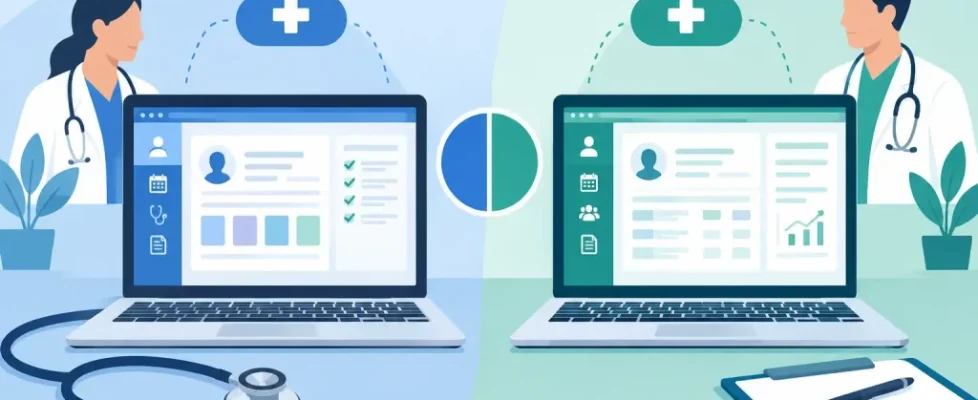
This is not a like-for-like product comparison. EClinicalWorks can support virtual visits within the broader EHR workflow. Dr. Miltie N9+ is better evaluated as a specialized remote-care and examination capability that may complement, rather than replace, the organization’s EHR.
The Clinical Difference: Video Visit vs. Remote Examination
The practical difference becomes clear when a clinician needs more than conversation. A standard telehealth encounter is well suited to medication counseling, behavioral health, care coordination, simple follow-up, and many low-acuity consultations. It may be insufficient when the provider needs a closer view of an ear, throat, skin condition, respiratory status, or other physical findings that influence triage and treatment planning.
A remote examination model is intended to close part of that gap. Connected peripheral tools and guided examination workflows can help extend the clinician’s presence into the patient’s setting. That has particular relevance in pediatrics, where a child may participate more successfully at home or in school with a caregiver or trained facilitator present. It can also matter in rural communities where travel for a brief follow-up can consume a full day for a family.
The trade-off is operational. Remote examination technology requires organizations to determine who will be with the patient, what training that person needs, how devices are cleaned and maintained, and when an in-person escalation remains necessary. No connected-care model should imply that every condition can be managed remotely. The value comes from applying the technology to appropriate clinical scenarios and clear escalation pathways.
Where eClinicalWorks Has the Stronger Role
An EHR platform carries responsibilities that extend beyond the encounter itself. eClinicalWorks may be a better fit when the immediate priority is centralized charting, appointment management, charge capture, claims workflows, quality reporting, patient portal activity, and longitudinal record management. These capabilities are foundational for many multi-site organizations.
For a practice replacing a fragmented record system, selecting a clinical examination solution without first addressing the core EHR environment would create a mismatch. The organization still needs a reliable source of truth for patient records, orders, documentation, and revenue-cycle processes.
EHR-centered telehealth can also reduce friction for clinicians who want virtual-visit scheduling and documentation inside familiar workflows. That convenience matters. Adoption suffers when providers must move across multiple disconnected applications, repeat data entry, or search for information after the visit has ended.
However, an EHR telehealth module should not automatically be assumed to provide the same depth of remote assessment as a dedicated connected-care platform. Buyers should ask specifically which examination peripherals are supported, how findings are captured, whether data can be documented in a clinically useful format, and what the provider can actually assess during a remote encounter.
Integration Is the Deciding Question for Many Organizations
The strongest care-delivery architecture is often not an either-or decision. A health system may retain eClinicalWorks as its EHR and operational backbone while adding a remote-exam platform for selected service lines, sites, or patient populations. In that model, the EHR manages the record and workflow, while the connected-care solution expands what clinicians can do remotely.
Before treating solutions as complementary, leadership should validate the integration pathway. Ask whether demographics, appointment context, encounter notes, images, measurements, and device-generated data can move into the designated clinical record without manual re-entry. Confirm how identity verification, user permissions, audit logs, data retention, HIPAA compliance, and consent are handled across systems.
Interoperability is not merely a technical preference. If data remains trapped outside the chart, care teams may lose time, documentation may be incomplete, and quality-review processes become harder to manage. A demonstration should follow an actual patient journey from scheduling through the remote encounter, documentation, follow-up order, billing workflow, and care-plan update.
Evaluate the Workflow by Site of Care
A pediatric practice, a nursing facility, a school-based program, and a rural clinic do not use remote care in the same way. The right evaluation should focus on the setting where care breaks down today.
For pediatric populations with special healthcare needs, examine whether caregivers can participate without excessive technical burden and whether clinicians can obtain usable findings in a lower-stress environment. For long-term care, assess whether nursing staff can facilitate exams efficiently and whether physician coverage can be extended after hours. For rural and safety-net organizations, measure whether the model reduces avoidable travel, preserves scarce specialist time, and supports local care teams rather than creating another disconnected referral channel.
Reimbursement and Governance Need Equal Attention
Technology selection does not establish reimbursement eligibility. Payment depends on the service, payer, clinician type, patient location, modality, documentation, and applicable federal and state rules. Organizations should involve coding, compliance, and contracting leaders early, especially when designing chronic care management, remote patient monitoring, or virtual follow-up programs.
A remote-exam platform may strengthen the clinical documentation supporting a visit, but it does not change the need for appropriate coding and medical necessity. Likewise, an EHR can organize documentation but does not guarantee that a virtual encounter is payable. The governance plan should define eligible use cases, required documentation, escalation criteria, device custody, infection-control procedures, staff responsibilities, and performance measures.
Useful measures include avoided transfers, time to specialist assessment, no-show rates, repeat visits, patient and caregiver satisfaction, clinician adoption, and the percentage of encounters in which remote findings changed the care plan. These metrics make the business case more credible than a simple count of completed video visits.
A Practical Buying Framework
Organizations comparing Dr. Miltie N9+ and eClinicalWorks should start with a concise statement of the problem. If the central need is an EHR, integrated scheduling, documentation, billing, and population management, evaluate eClinicalWorks as the core platform. If the central need is to make remote visits more clinically capable through connected examination and distributed care delivery, evaluate Dr. Miltie N9+ for that specialized role.
Then test each solution against a real use case, not a generic demonstration. A rural pediatric follow-up, a skilled nursing facility urgent assessment, or a chronic disease check-in will reveal workflow gaps more clearly than a polished product tour. Include frontline clinicians, operational leaders, IT, compliance, revenue cycle, and caregivers or patient representatives where appropriate.
Telehealth.Today views connected care as more than a video connection. The meaningful question is whether technology helps the care team obtain useful information, act on it quickly, and keep the patient connected to the right level of care. For organizations building that model, the next step is to map one high-value clinical pathway and choose technology based on the evidence, workflow, and access gains it can deliver.