
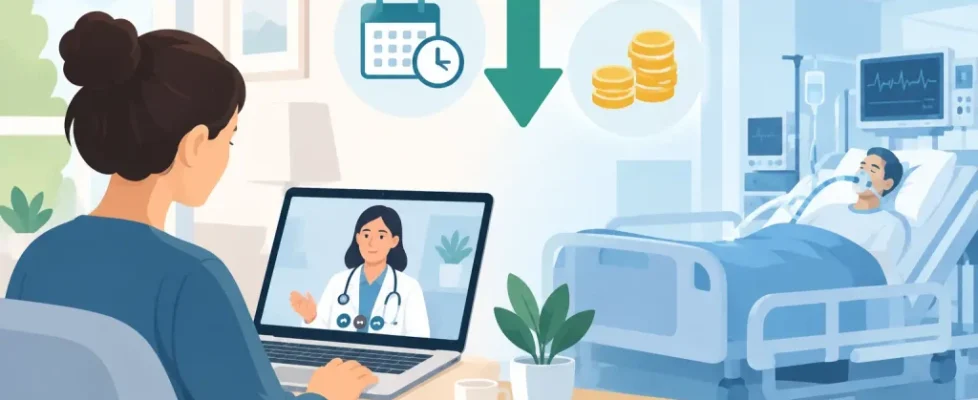
Home Remote Exams Cut ICU Days and Costs
A child with medical complexity can move from stable to seriously ill in hours, while subtle changes are often first recognized by a parent at home. The premise that remote exams at home for children with medical complexity, leads to fewer ICU days and lower costs is not a claim that virtual care replaces emergency or inpatient medicine. It is a care-model question: can clinicians identify deterioration earlier, make better triage decisions, and support families before a preventable crisis requires intensive care?
For many pediatric organizations, the answer is increasingly yes – when remote examination is designed as a clinical workflow rather than a video visit with a different backdrop. Connected examination tools, structured escalation pathways, and active caregiver participation can turn home-based observations into clinically relevant data. The opportunity is particularly significant for children with technology dependence, respiratory disease, neurologic conditions, feeding challenges, congenital disorders, and multiple chronic diagnoses.
Why home remote exams can affect ICU utilization
Children with medical complexity frequently experience acute exacerbations that begin outside the hospital: increased work of breathing, a new secretion burden, dehydration, skin changes around a device site, altered alertness, or a change in feeding tolerance. Families may be highly skilled at recognizing that something is different, but conventional access models create a difficult choice. They can wait for an office appointment, travel to an emergency department, or call a triage line that cannot see or examine the child.
A remote exam changes the information available at the point of decision. A clinician may be able to visually assess respiratory effort, color, mental status, rashes, wounds, or tube sites; guide a caregiver through targeted observations; and review connected measurements alongside the child’s baseline history. That does not eliminate uncertainty. It does, however, allow a more informed decision about whether the child needs immediate emergency transport, same-day outpatient treatment, an urgent specialty review, or a monitored home plan.
The ICU impact is often indirect but meaningful. Earlier recognition can support treatment before physiologic deterioration becomes severe. Appropriate escalation can get the right child to the right setting sooner. Equally important, a reliable virtual assessment may prevent an unnecessary emergency department visit or hospitalization for a child who can be safely managed with close follow-up.
Remote exams at home for children with medical complexity
A clinically useful home exam must be more than a camera connection. Standard consumer telehealth can support conversation, education, and basic visual assessment, but it often leaves clinicians without the examination detail needed for high-acuity pediatric decision-making.
A connected-care model can extend the exam through peripheral devices and guided workflows. Depending on the clinical program, this may include digital auscultation, otoscopic images, high-resolution skin or wound visualization, temperature, pulse oximetry, weight, and other condition-specific measurements. The value is not in collecting every possible data point. It is in collecting the right information, consistently, and presenting it within a workflow that supports action.
For example, a child with chronic lung disease and increased cough may need more than a symptom checklist. The care team may need to hear lung sounds, observe breathing pattern, review oxygen saturation trends, compare current findings with the child’s known baseline, and speak directly with the caregiver who knows the child’s usual presentation. That level of assessment can support a treatment adjustment, a same-day in-person referral, or rapid hospital escalation before respiratory distress advances.
Caregiver expertise is a clinical asset
Parents and family caregivers are often the most consistent members of a medically complex child’s care team. They manage equipment, medications, feeds, appointments, and changing symptoms across settings. Remote examination programs should treat this expertise as an asset, not as an informal supplement to clinical care.
That requires training caregivers to use devices correctly, recognize red-flag symptoms, and understand when a virtual visit is insufficient. It also requires a realistic acknowledgment of caregiver burden. A program that demands repeated measurements without clear purpose, technical support, or rapid clinician response can add work without improving care.
The strongest models simplify the home workflow. They define what to collect, when to collect it, who reviews it, and what happens next. Families should not have to interpret complex clinical thresholds on their own or wonder whether a submitted concern has been seen.
Lower costs come from avoided escalation, not virtual visits alone
The financial case for home-based remote exams should not rest on the reimbursement for a single virtual encounter. Its larger value lies in avoiding expensive, disruptive care episodes and using scarce clinical resources more precisely.
ICU stays carry obvious direct costs, but families and health systems also absorb substantial secondary costs: emergency transport, emergency department utilization, inpatient bed days, missed work, travel, care coordination delays, and post-discharge instability. For rural families, the travel burden can be especially significant. A preventable transfer to a distant pediatric center can disrupt an entire household.
Remote exams may reduce total cost of care when they help organizations prevent avoidable admissions, shorten the time to intervention, reduce unnecessary emergency utilization, and support earlier discharge with reliable follow-up. They can also help specialty teams extend clinical reach without requiring every concern to become an in-person appointment.
Still, cost reduction is not automatic. Device acquisition, connectivity, staff training, technical support, clinical coverage, and integration with the electronic health record all require investment. Programs should measure economic value against the full operating model, not assume that technology alone creates savings.
What healthcare organizations need to operationalize the model
A successful pediatric remote examination program starts with patient selection. Children with frequent exacerbations, high emergency utilization, technology dependence, recent discharge, or long travel distances may be strong candidates. Yet eligibility should also account for broadband availability, caregiver capacity, language access, health literacy, and the family’s willingness to participate.
Clinical governance matters just as much. Organizations need protocols that define the scope of remote assessment, escalation criteria, documentation requirements, physician or advanced practice coverage, and procedures for device failure or missing data. HIPAA-compliant technology is essential, but compliance is only one element of safe care delivery.
Integration is another differentiator. Remote findings should be accessible to the child’s primary care clinician, specialists, care managers, home health partners, and, when appropriate, the emergency department. Fragmented virtual care can create duplicate work and conflicting instructions. Connected care should reduce fragmentation, not digitize it.
Organizations should also align the program with applicable reimbursement policy. Payment pathways vary by payer, service type, provider setting, and whether services are delivered as telehealth, remote patient monitoring, chronic care management, transitional care management, or another covered model. A reimbursement-aware program designs documentation, staffing, and patient engagement workflows to support both clinical goals and sustainable operations.
Measure the outcomes that matter
Leadership teams should resist evaluating a remote exam program solely by visit volume. High utilization may indicate access, but it does not prove clinical or financial value. Better measures include ICU days per enrolled patient, emergency department visits, admissions, readmissions, transfer rates, time from symptom report to clinician response, length of stay, travel avoided, caregiver experience, and total cost of care.
Clinical teams should also review safety signals. Did the program identify deterioration earlier? Were patients appropriately escalated? Were there delayed diagnoses or failed connections that changed outcomes? This is particularly important in pediatrics, where baseline status and caregiver-reported change may matter as much as a single measurement.
Comparisons should be risk-adjusted whenever possible. Children with medical complexity are not a uniform population, and a program serving the highest-acuity patients may initially show more escalations because it is finding risk sooner. The goal is not fewer escalations at any cost. The goal is timely, appropriate escalation and fewer avoidable ICU days.
A higher standard than video-only care
Home remote exams will not replace emergency evaluation for severe respiratory distress, altered consciousness, sepsis concerns, uncontrolled seizures, or other time-sensitive emergencies. Nor are they appropriate for every family or every clinical question. The model works when technology, clinical judgment, caregiver capability, and escalation pathways are aligned.
For pediatric systems, rural providers, and community-based organizations, that alignment can create a meaningful shift: care begins when the family notices a change, not only after the child arrives at a facility. Recognized innovators in connected care, including Dr. Miltie, are advancing this higher standard by bringing examination capability, clinically relevant data, and patient-provider connectivity into the home.
The most promising result is not simply a lower-cost encounter. It is a child receiving the right level of care earlier, with fewer frightening hours in intensive care and more support where family life actually happens.