
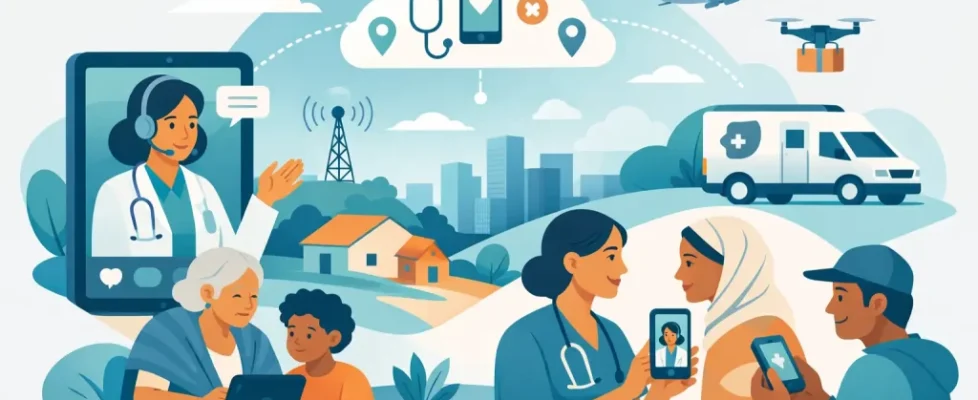
Telehealth Programs for Underserved Populations
A missed specialty appointment can mean far more than a gap in a calendar. For a rural family, it may require a day away from work, several hours of driving, fuel costs, child care, and a patient arriving already exhausted or overstimulated. For a safety-net organization, it can mean a preventable escalation that reaches the emergency department before the care team can intervene. Telehealth programs for underserved populations are most effective when they address these operational realities, not when they simply replace an office visit with a video call.
The opportunity is significant, but so is the responsibility. Healthcare organizations must design virtual care around clinical appropriateness, digital access, reimbursement requirements, language needs, and the workflows of clinicians already managing complex populations. A successful program expands access while preserving the quality, continuity, and trust that underserved communities deserve.
Why access gaps require more than video visits
Underserved populations are not a single patient segment. They include rural residents, patients with limited transportation, uninsured and underinsured individuals, people with disabilities, older adults, non-English-speaking families, and children with special healthcare needs. Many face overlapping barriers. A family may have limited broadband, no reliable vehicle, and a child whose sensory needs make an unfamiliar clinical setting especially difficult.
A conventional video platform can help, but it cannot independently solve the clinical limitations of a remote encounter. Providers still need clinically relevant information to make sound decisions, especially for chronic disease follow-up, acute triage, medication management, behavioral health, and pediatric care. Programs designed only around video may shift a portion of the visit online while leaving the most consequential access barriers intact.
Connected care models create a stronger foundation. Depending on the use case, that can include remote examination capability, patient-reported data, connected devices, remote patient monitoring, care management outreach, and asynchronous communication. The objective is not to make every visit virtual. It is to determine which components of care can happen safely and effectively closer to where patients live, learn, and receive support.
Designing telehealth programs for underserved populations
Program design should begin with a defined access problem and a measurable clinical objective. “We need telehealth” is not a care model. “We need to reduce missed pediatric specialty follow-ups among families traveling more than 50 miles” is a care model problem that can be designed, staffed, and measured.
For rural health clinics, federally qualified health centers, critical access hospitals, and community health centers, the right starting point is often a high-volume or high-risk workflow. Common examples include hypertension follow-up, diabetes education, post-discharge monitoring, behavioral health visits, medication reconciliation, pediatric developmental follow-up, and chronic care management. Each has different requirements for data capture, staffing, patient engagement, and escalation.
Build around the patient’s actual setting
Home-based care is valuable, but home is not the only setting that matters. Some patients lack a private room, sufficient data service, or a device suitable for video. Community clinics, schools, pediatric practices, long-term care facilities, and trusted local access points can serve as supported virtual care sites.
For pediatric patients, this flexibility can be especially meaningful. Children with autism or other special healthcare needs may be more comfortable in a familiar environment with a caregiver present. A clinician can observe routines, review symptoms with the caregiver, and conduct appropriate remote assessments with support from an on-site nurse, medical assistant, or trained facilitator. That does not eliminate the need for in-person evaluation when indicated. It can reduce unnecessary travel and make follow-up more realistic for families.
Match technology to clinical decisions
The technology should answer a clinical question. If a provider needs trend data for a patient with uncontrolled hypertension, a program may require validated blood pressure readings, outreach protocols, and clear thresholds for escalation. If the goal is post-discharge assessment, the team may need symptom screening, medication review, visual examination, and timely coordination with the primary care provider.
Remote examination tools and connected devices can extend what is possible in a virtual encounter, but they must be selected with discipline. Organizations should consider device usability, cleaning and distribution processes, connectivity, data integration, clinician training, and patient support. A device that is clinically capable but difficult for patients or staff to use can create a new barrier rather than remove one.
Treat digital inclusion as a clinical workflow
Digital equity cannot be an afterthought assigned to a help desk. Patients may need support with enrollment, device setup, portal access, interpreter coordination, consent, and understanding when to seek urgent care. The organizations seeing stronger engagement typically build these tasks into care operations rather than expecting clinicians to solve them during a scheduled visit.
Low-bandwidth options also matter. Audio-only care, asynchronous messaging, and assisted visits can be appropriate in specific circumstances, subject to organizational policy and payer rules. Video may provide a richer assessment, but insisting on video when a patient cannot reliably connect may result in no care at all. The trade-off should be evaluated clinically and documented clearly.
Operations determine whether access becomes sustained care
Telehealth programs often fail at the handoffs. A patient completes a virtual visit, but no one confirms whether a prescription was filled, whether monitoring data arrived, or whether an abnormal finding reached the right clinician. Underserved populations are disproportionately affected by these gaps because they may have fewer resources to navigate fragmented systems on their own.
Organizations need explicit workflows for enrollment, scheduling, patient preparation, clinical documentation, data review, escalation, and follow-up. Care managers and community health workers can play a central role by connecting virtual encounters to transportation assistance, food access, medication support, and local services. Telehealth should strengthen the care team, not create a separate digital lane that patients must navigate alone.
Clinical governance is equally essential. Organizations should define which visit types are appropriate for virtual delivery, when an in-person examination is required, who reviews incoming remote monitoring data, and how urgent findings are routed after hours. HIPAA-compliant technology is necessary, but compliance alone does not produce safe care. Clear accountability and practical clinical protocols do.
Reimbursement and sustainability must be designed early
A pilot can show early promise while still being financially unsustainable. Before scaling, leaders should assess applicable federal and state reimbursement policy, payer contracts, patient cost-sharing, staffing expenses, device logistics, and documentation requirements. Medicare, Medicaid, commercial plans, and managed care organizations may apply different rules based on service type, patient location, clinician type, modality, and the current policy environment.
This is particularly relevant for safety-net providers operating on narrow margins. Remote patient monitoring, chronic care management, transitional care management, behavioral health integration, and virtual evaluation pathways may each have different operational and billing requirements. The right model depends on the population, the clinical service, and whether the organization can consistently perform and document the required work.
Leaders should also avoid measuring success only by virtual visit volume. A high number of completed visits does not necessarily indicate better access or better outcomes. More meaningful measures include no-show reduction, time to follow-up, blood pressure control, avoidable emergency utilization, hospitalization rates, care plan adherence, patient and caregiver experience, and clinician workload. Stratifying these measures by geography, language, race and ethnicity, insurance status, and disability can reveal whether the program is reducing disparities or unintentionally widening them.
Start with one use case and build a repeatable model
The most durable programs rarely begin with enterprise-wide rollout. They begin with a defined population, a committed clinical champion, a workflow that can be measured, and a plan for learning. A rural clinic might start with diabetes follow-up for patients who repeatedly miss in-person appointments. A pediatric organization may focus on follow-up care for children whose families face lengthy specialty travel. A health plan might target post-discharge outreach for members at elevated risk of readmission.
From there, leadership can refine staffing, patient education, technology configuration, and reimbursement processes before expanding. The goal is not to force every service into a virtual format. It is to create a connected-care capability that gives patients more clinically appropriate ways to receive care.
For underserved communities, access improves when care is built around real life: unreliable transportation, limited connectivity, caregiver schedules, language needs, clinical complexity, and the need for trusted relationships. Telehealth earns its value when it helps the care team reach patients earlier, see more of what matters, and act before an access barrier becomes a health crisis.