
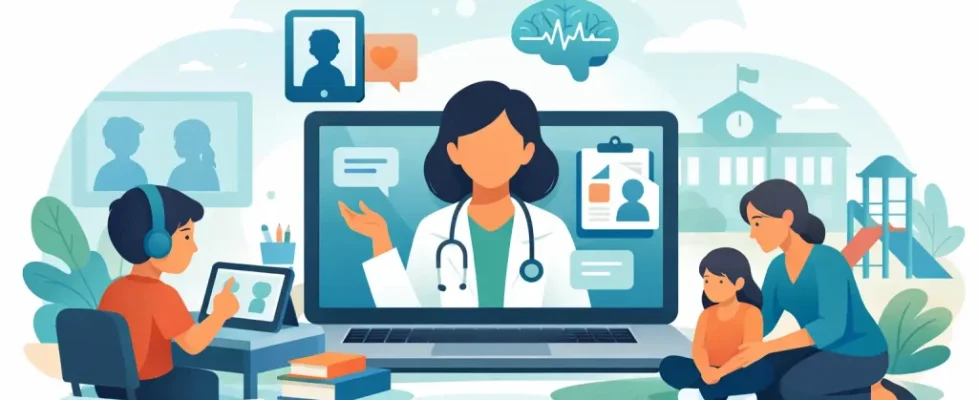
Virtual Pediatric Assessments for Schools
A student who develops wheezing after recess, reports ear pain during class, or struggles with medication side effects should not automatically lose an entire school day to a long drive and a crowded waiting room. Virtual pediatric assessments for schools create a clinically guided alternative: the child remains in a familiar setting while a qualified clinician can evaluate symptoms, review relevant data, involve the caregiver, and determine the next appropriate step.
For schools, pediatric practices, community health centers, and rural health organizations, the opportunity is not simply to add another video visit. It is to create a connected-care workflow that brings clinically relevant information, remote examination capability, and clear escalation pathways closer to where children spend much of their day.
Why the School Setting Matters
Schools are often the first place a health concern becomes visible. A school nurse, health aide, teacher, or behavioral support professional may notice an acute change before a caregiver can. That makes the school a valuable access point, particularly for families facing transportation barriers, limited appointment availability, inflexible work schedules, or long distances to pediatric specialists.
The value can be especially significant in rural communities and safety-net settings. A virtual assessment may help a rural health clinic or federally qualified health center extend pediatric expertise to multiple schools without requiring a clinician to travel between locations. It can also reduce avoidable emergency department referrals when an assessment supports a lower-acuity plan, while identifying children who truly need prompt in-person evaluation.
For autistic children and pediatric patients with special healthcare needs, familiar surroundings can matter clinically. A school-based virtual encounter may reduce sensory stress associated with unfamiliar clinics and help caregivers, school personnel, and clinicians compare a child’s current presentation with their usual functioning. That does not make every concern appropriate for virtual care, but it can make the right follow-up more accessible and less disruptive.
What a Virtual Assessment Can Support
A school-based virtual assessment is strongest when it is designed around defined use cases rather than positioned as a replacement for all pediatric care. Common scenarios include minor acute concerns, symptom follow-up, medication monitoring, chronic condition check-ins, behavioral health support, and post-discharge follow-up.
A child with a known asthma plan, for example, may benefit from a virtual clinician visit when symptoms emerge at school. The school health professional can report respiratory observations, verify medication administration, and share available measurements. The clinician can assess the child by video, speak with the caregiver, adjust the care plan within scope, or direct urgent in-person care if warning signs are present.
Remote examination tools can expand the clinical usefulness of the encounter. Depending on the care model, connected devices may provide temperature, pulse oximetry, heart rate, weight, or images and sounds from supported examination peripherals. The objective is not to collect data for its own sake. It is to provide data that are clinically relevant to the presenting problem and usable in a documented medical decision.
The limitations are equally important. Abdominal pain with concerning features, possible fracture, severe respiratory distress, altered mental status, suspected anaphylaxis, and other potentially emergent presentations require established emergency protocols. Video care should never delay emergency response. A mature program defines what can be handled virtually, what needs same-day in-person evaluation, and what triggers immediate emergency action.
Building the Clinical Workflow Before Launch
The technology is only one part of a functioning program. School leaders and healthcare partners need an operating model that answers who initiates the encounter, who obtains and documents consent, who remains with the student, how the caregiver joins, and where clinical documentation belongs.
In many models, the school nurse or designated trained staff member identifies an eligible concern using standing protocols. The caregiver is contacted and consent is confirmed according to organizational policy and applicable law. A virtual visit is then scheduled or initiated through a defined pathway, with the caregiver participating whenever possible. The clinician makes the assessment and communicates the plan to the caregiver and, only as appropriate, school staff who need information to safely support the child during the school day.
Clear role boundaries protect both the student and the program. School personnel should not be expected to diagnose, independently interpret complex findings, or operate clinical tools beyond their training and authorization. Likewise, the remote clinician needs enough context to make a sound decision: symptom onset, baseline condition, medication history, allergies, relevant care plans, and observations from the staff member who is physically present.
An effective workflow also closes the loop. The school needs to know whether the student may return to class, requires observation, should be picked up, or needs emergency transport. The caregiver needs visit instructions, follow-up expectations, and access to the clinician’s documentation. The pediatric provider needs records that support continuity of care rather than another isolated event in a fragmented chart.
Privacy, Consent, and Data Governance Are Design Requirements
School-based care operates at the intersection of education and healthcare privacy obligations. Health information maintained by a school may be governed by FERPA, while records maintained by a covered healthcare provider may fall under HIPAA. The exact arrangement depends on who provides the service, who maintains the record, contractual relationships, and applicable state requirements.
Organizations should avoid assuming that a video platform alone establishes compliance. They need written policies for caregiver consent, authorized access, private encounter spaces, record retention, communication with primary care providers, and disclosure of information to school staff. Legal and compliance teams should review the model before launch, particularly when third-party telehealth vendors, community clinics, or health plans are involved.
Privacy also has a practical dimension. A student should not conduct a sensitive pediatric or behavioral health visit in a busy health office with people moving through the room. Programs need a private space, reliable audio, appropriate camera positioning, and a process for confirming who is present. These details influence trust, candid communication, and clinical quality.
Making Virtual Pediatric Assessments for Schools Operationally Viable
The most durable programs begin with a limited set of high-value use cases and build from evidence. Launching with every possible complaint can overwhelm school staff and create inconsistent triage. Starting with conditions that have established protocols, engaged clinical partners, and measurable outcomes allows leaders to refine the model before expanding it.
Operational readiness depends on four connected capabilities:
- A clinical governance structure that defines eligibility, escalation criteria, supervision, and quality review.
- Training for school personnel on workflows, device use, privacy, caregiver communication, and emergency procedures.
- Reliable technology, including secure connectivity, an appropriate virtual care platform, and validated connected examination tools where needed.
- Documentation and reporting processes that connect the encounter to the healthcare organization’s clinical record and program metrics.
Measurement should extend beyond completed visit volume. Healthcare leaders should examine time from concern to clinician assessment, emergency department referrals, absenteeism, caregiver satisfaction, follow-up completion, and the percentage of encounters resolved without unnecessary removal from school. For chronic conditions, programs may also track plan adherence, symptom trends, medication access, and preventable exacerbations.
Reimbursement requires similar discipline. Coverage and payment rules vary by payer, state, provider type, service, location, and whether the encounter includes remote patient monitoring or other connected-care components. Organizations should validate coding, credentialing, telehealth policies, and documentation requirements before projecting revenue. Some models may be supported through clinical operations budgets, grants, value-based arrangements, school-health partnerships, or health plan contracts rather than fee-for-service billing alone.
The Partnership Model Determines the Experience
The strongest programs treat the school as a care-delivery partner, not merely a room with internet access. Pediatric practices contribute clinical accountability and continuity. Schools contribute daily context, trusted relationships, and an organized point of access. Community health centers and rural providers can contribute local reach and a pathway for students without an established medical home.
Caregivers remain central. They should understand when virtual care may be offered, how they participate, what information will be shared, and what happens if their child needs in-person treatment. A program that bypasses caregivers may appear efficient on paper but will struggle to earn sustained trust.
Virtual pediatric care in schools is most effective when it makes the next decision clearer. Sometimes that decision is a return to class with monitoring. Sometimes it is a prescription, a primary care appointment, specialty follow-up, or emergency transport. The innovation is not video alone. It is the ability to bring timely clinical judgment, connected data, and coordinated communication to the moment a child needs care.