
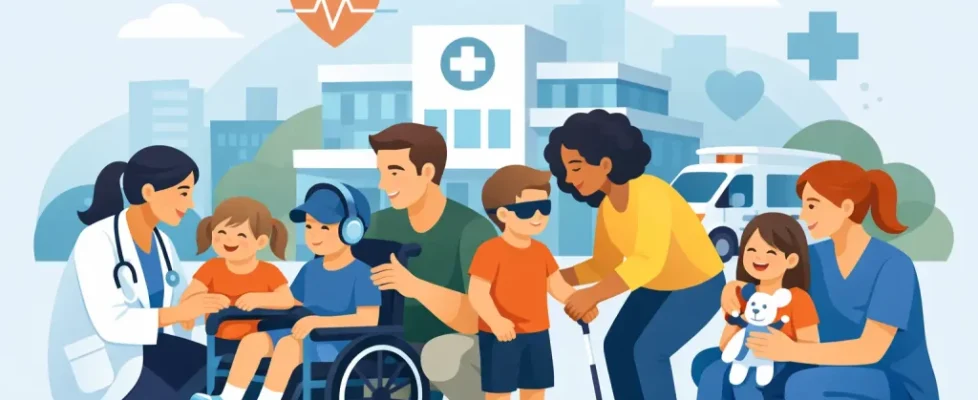
Improving Healthcare Access for Children with Special Needs
A missed pediatric appointment is rarely just an empty slot on a schedule. For families of children with complex medical, developmental, behavioral, or sensory needs, it can represent a lost workday, a long drive, disrupted routines, transportation uncertainty, and a child pushed beyond their tolerance for an unfamiliar setting. Improving healthcare access for children with special needs requires healthcare organizations to treat those barriers as clinical and operational concerns, not simply family logistics.
The opportunity is larger than adding video visits. Pediatric access improves when organizations redesign how care is delivered, who can participate, what information clinicians can obtain remotely, and how follow-up occurs between in-person encounters. Telehealth, connected-care tools, and remote examination capabilities can extend the reach of pediatric specialists and primary care teams while giving caregivers a more active role in the care plan.
Why standard access models fall short
Children with special healthcare needs often receive care across multiple settings and disciplines. A pediatrician may need input from developmental specialists, behavioral health clinicians, therapists, school personnel, home health providers, and subspecialists. Yet each service may use a different workflow, location, scheduling process, and communication channel.
This fragmentation creates a predictable access gap. Families may have insurance coverage but still lack a nearby specialist, reliable transportation, appointment availability outside school hours, or a care environment their child can tolerate. Rural communities face an additional constraint: the relevant pediatric expertise may be hours away, and a referral alone does not create practical access.
For many children, the clinical environment itself can be a barrier. Bright lights, waiting-room noise, unfamiliar staff, transitions, and prolonged delays can intensify anxiety or sensory distress. A virtual visit from home will not replace every physical exam or diagnostic service, but it can allow clinicians to observe behavior, function, medication effects, routines, and caregiver concerns in a setting that is more representative of daily life.
Improving healthcare access for children with special needs through hybrid care
The strongest model is usually hybrid, not virtual-only. Organizations should identify which encounters require hands-on evaluation and which can be delivered effectively at home, in a school, at a pediatric practice, or through a community clinic supported by virtual specialty consultation.
Medication follow-up, chronic care management, behavioral health check-ins, care-plan reviews, caregiver education, triage, and post-discharge follow-up are often well suited to virtual care. These encounters can reduce unnecessary travel while helping the team identify whether a child needs an expedited in-person visit.
Some visits become more clinically useful when connected devices or remote examination tools are available. Depending on the care model and clinician scope, teams may gather vital signs, visual observations, symptom history, images, or other clinically relevant data before or during the virtual encounter. The point is not to force every exam into a remote format. It is to give clinicians enough information to make sound decisions, document appropriately, and escalate care when the remote setting is not sufficient.
Design visits around the child and caregiver
Pediatric telehealth workflows should not be copied directly from adult virtual care programs. Caregivers may need pre-visit coaching, technology support, interpreter access, and clear guidance about how to prepare the child. A team may need extra time to establish rapport, observe the child without pressure, or collect history while the child takes a break.
Scheduling also matters. Offering early morning, late afternoon, or school-coordinated appointments can reduce absenteeism and caregiver work disruption. For families without reliable broadband, organizations should consider telephone-based workflows when clinically appropriate, community access sites, device-lending programs, and care coordinators who can help address digital barriers.
Consent, privacy, and HIPAA-compliant communication must be built into the workflow from the start. That includes defining where visits may occur, who can be present, how clinical data are documented, and how caregivers can send information without relying on unsecured consumer messaging.
Bring the care team into the same workflow
The value of virtual care rises when it reduces fragmentation rather than adds another point solution. Care managers should be able to see completed visits, unresolved concerns, referrals, care-plan updates, and follow-up responsibilities in a timely way. Primary care teams need a clear pathway for acting on specialist recommendations, while specialists need enough context to understand the child’s current medications, recent acute care use, and family priorities.
A practical model may include a designated pediatric care coordinator who prepares the family, confirms technology readiness, gathers questions in advance, and closes the loop after the visit. That coordinator can also identify recurring barriers, such as missed transportation, equipment needs, lack of respite care, or difficulty obtaining medications. These are not peripheral issues. They often determine whether a carefully developed treatment plan can actually work.
School-based and community-based partnerships can further extend access. A school nurse, community health worker, or local clinical staff member may help facilitate an appointment when appropriate permissions, training, and privacy safeguards are in place. For rural health clinics, federally qualified health centers, and critical access hospitals, this hub-and-spoke approach can connect children to pediatric specialty expertise without requiring every community to recruit every specialist locally.
Measure access as a clinical performance outcome
Organizations should avoid defining success by virtual-visit volume alone. A high number of video visits may indicate adoption, but it does not prove that children are receiving timely, effective, equitable care.
Leadership teams should track operational and clinical measures that reflect the patient experience and program value. Useful indicators include time to next available appointment, no-show rates, completed referral rates, travel avoided, emergency department utilization, caregiver-reported burden, adherence to follow-up plans, and the percentage of encounters resolved without an unnecessary in-person visit. For chronic and medically complex populations, teams may also monitor care-plan completion, medication follow-up, avoidable readmissions, and gaps in preventive services.
Equity should be visible in the data. Compare utilization and outcomes across geography, language preference, race and ethnicity, payer type, disability-related accommodations, and broadband access where possible. If virtual care adoption is concentrated among families who already have devices, flexible work schedules, and reliable connectivity, the program may widen the very access gap it was designed to address.
Build a reimbursement-aware operating model
Pediatric access programs need clinical ambition and financial discipline. Reimbursement policy varies by payer, state, service type, provider credentialing, patient location, and modality. Organizations should establish a process for verifying coverage rules, eligible service codes, documentation requirements, consent expectations, and billing guidance before scaling a program.
This is particularly relevant for safety-net providers that operate with limited administrative capacity. A sustainable model should clarify which services can be billed, which access supports may require grant funding or partnership investment, and how virtual care contributes to broader value-based goals such as quality performance, continuity of care, and avoidable utilization reduction.
Technology selection must also match the clinical workflow. A basic video platform may be adequate for counseling or straightforward follow-up, but it may not support programs that need remote examination, patient-generated data, structured triage, chronic care management, or coordinated documentation. The right level of capability depends on the patient population and service line. Buying more technology than the workflow can support creates friction; buying too little can leave clinicians unable to make clinically confident decisions remotely.
Start with a defined use case, then scale deliberately
The most effective programs begin with a narrow problem that has clear patient impact. A health system might focus first on post-discharge follow-up for medically complex children, behavioral health access for rural families, developmental care coordination, or specialty consults delivered through community pediatric practices.
Clinical leaders, operations staff, IT, compliance, revenue cycle, and family representatives should define the care pathway together. That work includes eligibility criteria, escalation protocols, staffing responsibilities, technology support, documentation standards, and measures of success. Families should be asked directly which parts of the existing process create the most burden. Their answers frequently point to operational fixes that dashboards do not reveal.
Care should not become less personal because it becomes more distributed. When virtual care is designed as part of a connected pediatric model, it can give children access to the right clinician at the right time while preserving the in-person care that remains essential. For organizations serving these families, the next meaningful improvement may be as practical as a better follow-up pathway, a facilitated specialty visit, or a clinician who can see the child’s real environment before asking the family to make another difficult trip.