
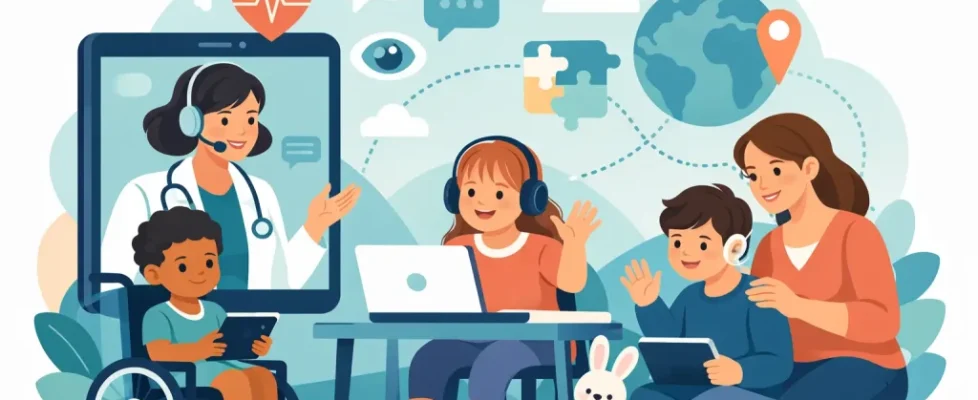
Virtual Care for Pediatric Special Needs Populations
A 90-minute trip to a specialty appointment can be more than an inconvenience for a child with sensory sensitivities, mobility limitations, complex medical needs, or anxiety around unfamiliar environments. It can mean missed school, missed work, disrupted routines, and an appointment that begins with a dysregulated patient. Virtual care for pediatric special needs populations changes where care can happen – but only when organizations design the model around clinical appropriateness, caregiver capacity, and reliable follow-through.
For pediatric practices, health systems, rural clinics, and safety-net organizations, the opportunity is not to replace in-person care. It is to make the right parts of care more available, observable, and connected between visits.
Why pediatric virtual care requires a different operating model
Children with special healthcare needs are not a single clinical group. They may include autistic children, children with developmental disabilities, medically complex patients, children using assistive technology, and those requiring behavioral health, therapy, specialty, or chronic disease follow-up. Their families often coordinate multiple providers, medications, school services, equipment, and transportation arrangements.
A standard video visit platform addresses only one part of that equation: conversation. Pediatric special needs care often requires a fuller view of function, symptoms, behavior, caregiver observations, medication adherence, and the home environment. A clinician may need to see a feeding setup, examine a rash with guided imaging, review home vital-sign trends, observe gait, or understand why a care plan is difficult to carry out after school.
That makes virtual care a connected-care workflow, not simply a video encounter. The strongest programs combine scheduled visits with secure messaging, remote patient monitoring where clinically indicated, structured caregiver intake, coordinated documentation, and clear escalation pathways. The clinical objective should determine the technology and workflow – not the other way around.
Where virtual care for pediatric special needs populations adds value
Virtual care is especially useful when the central need is assessment, education, follow-up, coordination, or monitoring rather than a procedure-dependent physical examination. It can lower access barriers for families who live far from pediatric specialists or who must arrange accessible transportation and childcare for siblings.
Follow-up care that does not require a clinic room
Many follow-up encounters can be conducted effectively through a secure virtual workflow. Examples include medication checks, behavioral health visits, care-plan reviews, therapy coaching, nutrition follow-up, sleep concerns, and post-discharge check-ins. For children with chronic conditions, frequent lower-burden touchpoints may identify emerging issues before they become urgent.
The value is often operational as well as clinical. When a family can connect from home, a school health office, a pediatric practice, or a community clinic, missed appointments may decline and caregivers can participate without taking an entire day away from work. That does not guarantee engagement. Families still need device access, broadband, language support, and confidence using the technology. But a thoughtfully supported virtual option removes a barrier that many organizations have treated as unavoidable.
Better context for developmental and behavioral care
For some children, a familiar environment produces more representative observations than a clinic visit. Caregivers may be able to show routines, communication supports, sensory triggers, feeding practices, or behavioral patterns as they occur in context. A clinician can also coach caregivers in real time, turning the visit from retrospective reporting into a practical intervention.
This advantage has limits. A home observation is not automatically more accurate, and it should not substitute for an in-person developmental assessment when direct standardized testing or hands-on examination is required. Programs should establish which visit types are clinically appropriate for virtual delivery and which findings should trigger an in-person evaluation.
Connected monitoring for higher-risk populations
For selected pediatric patients, clinically relevant data collected between encounters can strengthen chronic care management. Depending on diagnosis and care plan, this may include weight, blood pressure, pulse oximetry, glucose data, symptom surveys, seizure logs, or caregiver-reported functional changes.
The critical word is selected. Monitoring programs should not create a stream of data that nobody owns or reviews. Organizations need defined thresholds, assigned clinical roles, documented response times, and escalation protocols. If a child’s oxygen saturation reading or symptom report signals possible deterioration, the family must know whether to contact the care team, schedule an urgent virtual assessment, seek same-day in-person care, or call emergency services.
Remote examination capability should match the clinical question
The limitation of conventional telehealth is clear: a video call cannot reliably reproduce every component of a pediatric physical examination. Organizations should be direct about that limitation rather than overstate what virtual visits can accomplish.
At the same time, remote examination capability has advanced beyond a webcam conversation. Connected peripheral devices, caregiver-guided examination techniques, and telepresenter-supported visits can extend what clinicians can assess from a distance. In a rural health clinic, school-based setting, or community site, trained staff may assist with vital signs, otoscopic images, skin findings, lung sounds, or other clinically appropriate data collection. The supervising clinician can then make a more informed decision about treatment, referral, or the need for in-person evaluation.
This model is particularly valuable when specialty access is limited. It can help community-based teams keep the child closer to home while bringing specialty expertise into the encounter. Still, device availability, staff training, image quality, infection-control processes, and interoperability all affect whether the model is useful in practice. Technology alone does not create a clinically defensible remote exam.
Design for caregivers, not just patients
In pediatric special needs care, caregivers are frequently the primary operators of virtual care. They prepare the child, explain symptoms, use devices, manage portal messages, and carry out care instructions. A program that assumes every caregiver has time, privacy, digital literacy, English fluency, and reliable connectivity will widen disparities instead of reducing them.
Care design should account for family reality. Offer simple pre-visit instructions, flexible scheduling, interpreter access, accessible materials, and a live support option when technology fails. Ask in advance whether the child communicates using an augmentative device, needs visual schedules, has sensory needs, or benefits from a shorter visit with planned breaks. These details are not administrative extras. They influence the quality of the clinical encounter.
Caregivers also need a clear answer to a basic question: what happens next? Every virtual visit should close with an understandable plan, medication and equipment instructions when applicable, a pathway for questions, and defined criteria for escalation. Fragmented follow-up is a common risk for families managing complex care across multiple systems.
Build the workflow before scaling the program
Healthcare organizations often begin with a technology procurement decision and address workflow later. Pediatric virtual care programs should reverse that order. First identify the patient cohorts, encounter types, clinical goals, and access gaps the organization intends to address. Then build the operational model around them.
A practical implementation plan should define eligibility criteria, consent processes, HIPAA-compliant technology standards, documentation expectations, scheduling rules, device logistics, and staff responsibilities. It should also specify how virtual encounters connect to the electronic health record, care management team, primary care provider, school or community partners, and specialty services.
Reimbursement must be considered early, particularly for organizations serving Medicaid populations and patients with complex needs. Coverage, eligible providers, originating-site rules, remote monitoring requirements, and payment policies vary by payer and state. A financially sustainable program needs a reimbursement-aware workflow, accurate coding practices, and a clear understanding of which services create value even when reimbursement is limited. Reduced no-shows, avoided transfers, better care coordination, and earlier intervention may matter to the organization even when they do not map neatly to a single claim.
Measure what matters to children and families
Utilization metrics matter, but visit volume alone does not demonstrate success. Organizations should examine completed-visit rates, time to specialty access, emergency department use when relevant, follow-up completion, caregiver experience, clinical outcomes, and staff workload. Equity measures are equally important: Who is using the service? Who is unable to connect? Which barriers persist by geography, language, disability, insurance, or broadband access?
A virtual model that works well for a digitally confident suburban family may fail a rural family with limited connectivity or a caregiver managing several jobs. Hybrid care models are often the more durable answer. They preserve in-person access for examinations and relationship-building while using virtual care to make the overall care plan more responsive.
The goal is not to make every pediatric encounter virtual. It is to build a care system that asks less of families when less is required of them, brings clinicians closer when distance is the problem, and recognizes when a child needs hands-on care. For pediatric special needs populations, that is where virtual care becomes clinically meaningful rather than merely convenient.