
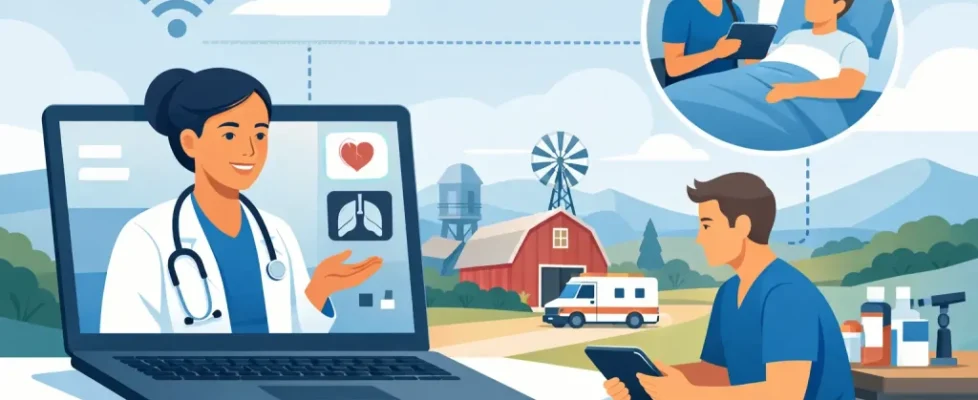
Virtual Exam Benefits for Rural Healthcare Providers
A patient in a frontier community may spend more time driving to a follow-up visit than speaking with the clinician. For a rural health clinic or critical access hospital, that travel burden can turn a manageable chronic condition into a missed appointment, delayed escalation, or avoidable emergency department visit. The benefits of virtual examinations for rural healthcare providers are most meaningful when virtual care moves beyond a video conversation and supports clinically relevant assessment where the patient already is.
A virtual examination can combine live audio-video consultation with connected examination tools, remote patient monitoring data, and a trained local facilitator when needed. It does not eliminate the need for hands-on care, imaging, laboratory testing, or emergency evaluation. It does give rural organizations another clinical pathway for situations in which distance, staffing shortages, weather, transportation, or specialty availability would otherwise interrupt care.
Benefits of Virtual Examinations for Rural Healthcare Providers
The primary benefit is not technology for its own sake. It is a stronger capacity to place the right clinician, the right information, and the right level of care in front of a patient without requiring every encounter to occur in a distant office.
For rural providers, virtual examination capability can extend local clinical capacity. A family physician, nurse practitioner, school nurse, paramedic, community health worker, or bedside nurse can support an encounter while a remote specialist participates in real time. Depending on the model and equipment available, the remote clinician may be able to review high-quality images, listen to heart and lung sounds, inspect the ear or throat, evaluate skin findings, or guide a focused assessment.
That changes the practical value of telehealth. Standard video visits are well suited to counseling, medication review, behavioral health, and many follow-ups. Yet video alone may leave a clinician without enough objective information to make a confident decision. Connected examination workflows can help close that gap, especially for common complaints that otherwise lead to a long referral trip or a precautionary transfer.
More access without weakening clinical judgment
Rural communities often face limited specialty coverage in pediatrics, behavioral health, cardiology, dermatology, endocrinology, and other fields. Virtual examinations allow organizations to build scheduled specialty access or rapid consultation pathways without waiting for a specialist to establish a full-time local presence.
This can support better triage. A remote clinician may determine that a patient can be managed locally with a treatment plan and close follow-up, needs an in-person appointment within a defined timeframe, or requires immediate escalation. The point is not to avoid transfer at all costs. It is to make transfer decisions with more clinical context.
For critical access hospitals, this distinction can be operationally significant. When a patient requires a higher level of care, virtual examination data can improve the handoff to the receiving organization. When local management is appropriate, a virtual consult may preserve scarce transport resources and reduce disruption for patients and families.
Better continuity for chronic and post-acute care
Rural health organizations are frequently managing patients across wide geographic areas, often with chronic disease, mobility limitations, or inconsistent transportation. Virtual examinations can make follow-up more practical after an emergency visit, hospital discharge, medication change, or new diagnosis.
A video interaction paired with connected data is more actionable than a check-in call alone. For example, a clinician supporting a patient with heart failure may review symptoms, weight trends, blood pressure readings, oxygen saturation when appropriate, medication adherence, and visible signs of swelling. A concerning change can trigger a same-day plan rather than waiting for the next scheduled office visit.
The same model can strengthen chronic care management for diabetes, COPD, hypertension, and other conditions where small changes matter. It depends on a defined workflow: who reviews incoming information, what thresholds warrant outreach, and how the care team documents and closes the loop. Technology does not solve follow-up gaps by itself. Clear accountability does.
A lower-burden care setting for children and caregivers
For pediatric patients, the location of care can shape the quality of the encounter. Long travel can mean missed school, lost wages for caregivers, disrupted routines, and added stress before a child even reaches the appointment. These burdens can be especially acute for autistic children and children with special healthcare needs.
Virtual examinations can bring a pediatric specialist into a familiar setting such as a home, school-based health setting, pediatric practice, or community clinic. Caregivers can participate more fully because they are not separated from the encounter by travel logistics. They can show the clinician a medication, describe a concern in the child’s usual environment, and help clarify what has changed between visits.
There are limits. A child with respiratory distress, dehydration, altered mental status, or another urgent concern still needs prompt in-person assessment. But for follow-up, developmental support, chronic-condition monitoring, medication management, and selected acute concerns, virtual examination can reduce friction while preserving meaningful clinical engagement.
Virtual Examination Data Can Improve Rural Care Decisions
The value of connected examination tools lies in the quality and usability of the information they produce. A clinician needs data that can be interpreted in context, documented appropriately, and acted on within the care plan. A disconnected collection of device readings creates work. A thoughtfully designed virtual examination workflow supports decisions.
Consider a rural clinic evaluating a patient with a possible ear infection. Video may show a child who appears uncomfortable, but it may not provide enough detail to assess the tympanic membrane. If a trained staff member can capture an exam image with a connected otoscope and share it during the encounter, the remote clinician has a more informed basis for determining next steps. Similar principles apply to auscultation, dermatologic images, vital signs, and other focused findings.
Data quality remains essential. Devices must be fit for the intended use, staff and patients need training, and clinicians need to know when the available information is insufficient. Virtual examination should increase clinical confidence, not create false confidence.
Operational Gains Matter as Much as the Encounter
For rural and safety-net organizations, the business case is rarely a single metric. Leaders need to consider access, staff utilization, patient experience, avoidable utilization, service-line reach, and reimbursement policy together.
A well-designed model can reduce appointment no-shows by removing travel barriers. It can allow a specialist to see patients across multiple sites in a single session. It can also give local clinicians a practical route to consultation, reducing professional isolation and supporting retention in communities where recruitment is difficult.
The model must still fit staffing reality. A facilitated virtual examination requires someone on site who can prepare the patient, operate the equipment, and support the clinician’s instructions. In some settings, that role fits naturally within nursing or medical-assistant workflows. In others, it can become an unfunded burden unless scheduling, visit volume, and responsibilities are planned carefully.
Reimbursement requires the same discipline. Coverage, eligible provider types, originating-site rules, modality requirements, and payer documentation expectations vary by payer and can change. Organizations should validate the applicable Medicare, Medicaid, commercial payer, and state policy requirements before forecasting revenue. Clinical documentation should reflect the services actually delivered, the remote participants, the technology used when relevant, and the medical decision-making that supported the plan.
Building a Model That Clinicians Will Use
Successful rural virtual examination programs start with a defined use case rather than a broad promise to digitize care. An organization may begin with post-discharge follow-up, pediatric specialty access, after-hours triage, chronic disease escalation, or consultation support for a community clinic. The best starting point is usually a high-friction care gap with enough patient volume to build a repeatable workflow.
Before launch, clinical and operational leaders should establish four basics:
- Patient selection criteria that identify when virtual examination is appropriate and when in-person evaluation is required.
- Escalation pathways for urgent findings, failed technology, abnormal device readings, and patient deterioration.
- Role-based training for facilitators, clinicians, scheduling teams, and patients or caregivers.
- HIPAA-compliant technology, identity verification, consent processes where required, documentation standards, and data governance.
Pilot results should be measured with operational and clinical discipline. Track completed visits, time to specialist input, travel avoided, no-show rates, patient and caregiver experience, referral patterns, escalation outcomes, and staff effort. Numbers alone do not tell the full story. A program that increases visit volume but overwhelms nurses or produces inconsistent data needs redesign before expansion.
Virtual examination is most effective when it is treated as a care-delivery capability, not a video platform feature. Rural providers do not need to reproduce every in-person encounter at a distance. They need practical ways to bring clinically credible assessment closer to patients, while retaining clear pathways to hands-on care when the condition demands it. Start with the care gap patients feel most acutely, build the workflow around real clinical decisions, and let the model earn trust one well-managed encounter at a time.