Amwell Doesn’t Have Remote Exams. Dr. Miltie N9+ Does
If your telehealth program stops at video, you already know the ceiling. A clinician can see a patient, talk through symptoms, and make a judgment call, but when the encounter requires exam-grade information, the gap becomes obvious. That is the core issue behind the phrase amwell doesn’t have a remote exam, the Dr. Miltie N9+ does – and for healthcare organizations trying to extend care beyond the clinic, that difference is operational, clinical, and financial.
A basic virtual visit platform can support access. It can reduce travel, improve convenience, and help with low-acuity follow-up. But convenience alone is not the same as remote clinical capability. For hospitals, rural clinics, pediatric practices, home-based care models, and safety-net organizations, the question is not whether video matters. It does. The question is whether video-only telehealth is enough for the patient populations they actually serve.
Why “amwell doesn’t have a remote exam, the Dr. Miltie N9+ does” matters
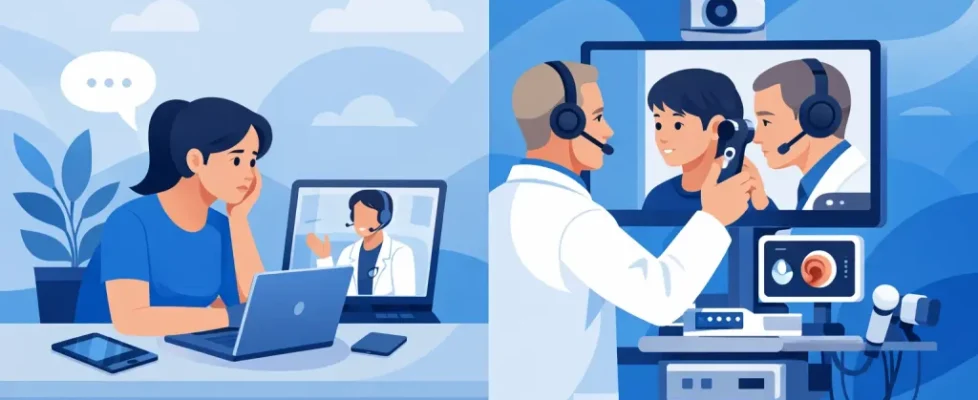
The distinction matters because a remote exam is not a cosmetic feature. It changes what can happen during the encounter. When clinicians can capture clinically relevant data remotely rather than relying only on patient description and visual observation through a webcam, the visit can move closer to a true assessment instead of a limited conversation.
That has implications across care settings. In pediatrics, a child with sensory sensitivities or developmental challenges may engage more successfully from home or school than in a high-stimulation office environment. In rural care, a patient may not be able to drive several hours for a follow-up that mainly needs focused exam information and provider interpretation. In chronic care management, the problem is often not patient willingness but the practical difficulty of obtaining timely data between in-person visits.
A standard telehealth platform addresses part of the access problem. A remote examination platform addresses part of the clinical limitation that remains.
Video visits are useful, but they have a hard limit
Healthcare leaders evaluating virtual care platforms should be careful not to flatten all telehealth into one category. Video conferencing, provider scheduling, secure communication, and documentation support are valuable. They are also increasingly common. What separates systems is whether they can support exam-informed care rather than video-mediated discussion alone.
That distinction becomes especially important in settings where the patient is not physically near the clinician. Home health agencies, long-term care facilities, schools, community clinics, and mobile care teams need more than a camera and microphone if they are expected to support higher-quality remote assessment. A provider may need a closer clinical view, device-enabled information, or other exam inputs that move the visit beyond approximation.
This is where the comparison in the keyword becomes meaningful. Saying Amwell does not have a remote exam while the Dr. Miltie N9+ does is not a trivial feature comparison. It points to two different care models. One is centered on virtual communication. The other is built around virtual examination capability.
What a remote exam changes in real care delivery
Remote exam capability can improve decision quality, but it also changes workflow design. When clinicians receive more useful information during the encounter, they may reduce unnecessary escalations, shorten the path to intervention, or determine more confidently when an in-person evaluation is truly needed.
That matters for organizations managing constrained resources. A rural health clinic does not want to bring every patient on site if some issues can be handled safely and effectively through a remote care pathway. A pediatric specialist does not want every family to lose half a day to travel when the follow-up could have been completed with the right exam tools. A care manager supporting chronic disease populations needs more than a check-in if the goal is early identification of decline.
There are trade-offs, of course. Remote exam technology is not a replacement for every physical visit, and no serious healthcare organization should frame it that way. Some conditions still require hands-on assessment, imaging, lab work, procedures, or immediate in-person escalation. But the relevant standard is not whether remote exams replace all in-person care. It is whether they expand the range of clinically appropriate care that can be delivered remotely.
For many organizations, that answer is yes.
Where Dr. Miltie N9+ fits differently
The Dr. Miltie N9+ is positioned differently from conventional telehealth platforms because it is not limited to facilitating a video conversation. It is built around the premise that connected care should include remote examination capability, clinically relevant data capture, and a stronger bridge between virtual access and actual clinical evaluation.
That is a material difference for provider buyers. Clinical leadership is looking for quality and appropriateness. Operations leaders are looking for workflows that scale. Financial stakeholders are looking at reimbursement alignment, avoidable utilization, and program sustainability. A platform that supports remote exams addresses those concerns more directly than one that stops at video.
This is especially relevant in distributed care environments where the person assisting the patient may be a caregiver, school staff member, nurse, community health worker, or facility-based team member. In those models, the platform needs to support guided data collection and a more exam-capable encounter, not just a digital meeting room.
The pediatric and special-needs angle is easy to underestimate
For pediatric populations, remote exam capability can be more than a technical upgrade. It can change the care setting in ways that reduce stress and improve participation. Children with autism and other special healthcare needs often do better in familiar environments, with caregivers present and fewer sensory demands. A remote encounter that includes meaningful exam capability can make those settings clinically productive instead of merely convenient.
That does not eliminate the need for office visits. It does, however, create a more flexible continuum. Routine follow-up, targeted assessments, caregiver-supported observation, and certain symptom reviews may be handled more effectively when the technology supports more than face-to-face video.
Healthcare organizations serving these populations should think carefully about what kind of virtual care they are actually implementing. If the model is intended to support better access but still leaves the clinician without enough information to assess the patient confidently, the program may underdeliver despite high utilization.
Reimbursement and operational value depend on capability
Decision-makers responsible for telehealth expansion are not evaluating features in a vacuum. They are asking whether the platform supports clinically appropriate workflows, documentation quality, patient engagement, and reimbursement-aware care models. That is where remote exam capability becomes strategically relevant.
A video-only encounter may be sufficient for some use cases, but limited clinical input can reduce confidence, increase follow-up friction, or trigger more downstream in-person utilization than necessary. By contrast, a more capable remote exam model may support stronger triage, better continuity, and more efficient use of clinician time.
There is still an implementation question. Technology alone does not create value. Organizations need training, workflow design, role clarity, and use-case selection. The best results usually come from starting with defined populations and scenarios where remote exams solve a real bottleneck – chronic disease follow-up, rural specialty access, post-discharge review, school-based assessments, or facility-based evaluations.
The wrong approach is to assume every virtual care problem has the same solution. The right approach is to match platform capability to clinical intent.
How to evaluate this comparison as a healthcare buyer
If you are assessing whether Amwell or a remote exam platform is the better fit, start with a simple question: what kinds of encounters do your clinicians need to conduct remotely, and what information do they need to do them well?
If your use case is mostly administrative follow-up, medication discussion, or low-acuity consultation, a standard telehealth platform may be adequate. If your organization is trying to support exam-informed care across homes, schools, community sites, long-term care, or rural settings, the absence of remote exam capability is not a minor limitation. It is the main limitation.
That is why the statement “amwell doesn’t have a remote exam, the Dr. Miltie N9+ does” resonates with provider organizations that have moved past first-generation telehealth goals. They are no longer asking only how to launch video visits. They are asking how to deliver more clinically credible care at a distance.
That shift is where recognized innovators stand apart. The market no longer needs more generic virtual visit tools. It needs technology that helps clinicians examine, assess, monitor, and decide with greater confidence outside the four walls of the clinic.
The most useful telehealth platform is not the one that looks modern on a procurement checklist. It is the one that makes remote care feel less limited for the people responsible for delivering it.